

The Scottish Government has stepped up calls for the devolution of energy policy, with Energy Minister Stephen Gethins arguing that handing powers to Holyrood could help reduce household bills, tackle fuel poverty, and strengthen economic resilience.
The move follows backing from the Scottish Parliament for a motion seeking the formal transfer of energy policy from Westminster. Ministers say control over energy decisions would allow Scotland to better harness its natural resources and shape policies tailored to local needs.
Focus on affordability and energy security
At the heart of the proposal is a belief that devolved powers would give Scotland greater control over pricing, infrastructure, and investment – enabling a more direct response to cost pressures facing households and businesses.
Mr Gethins said such powers would support a shift towards a cleaner, more affordable energy system, while protecting consumers from global market volatility, which has driven recent bill increases across the UK.
The Scottish Government argues that Scotland’s significant renewable energy potential – particularly in wind and hydro – could be better leveraged to support domestic consumers if policy decisions were made locally.
Formal request to UK Government
Following the parliamentary vote, the Energy Minister is expected to formally engage with UK ministers to begin discussions on the transfer of powers. While constitutional and political challenges remain, the move reflects a broader push for greater control over key economic levers.
Stephen Gethins, Scottish Energy Minister, said:
“This government has been returned with a clear instruction to deliver the benefits of Scotland’s abundant energy resources to households, communities, and businesses. That is what we intend to do.
“The future lies in clean, affordable, and secure power – strengthening affordability, resilience and competitiveness, and protecting Scottish people and businesses from their energy bills being dictated by events halfway across the world. After the UK Government announced bills would go up again, that is more important than ever.
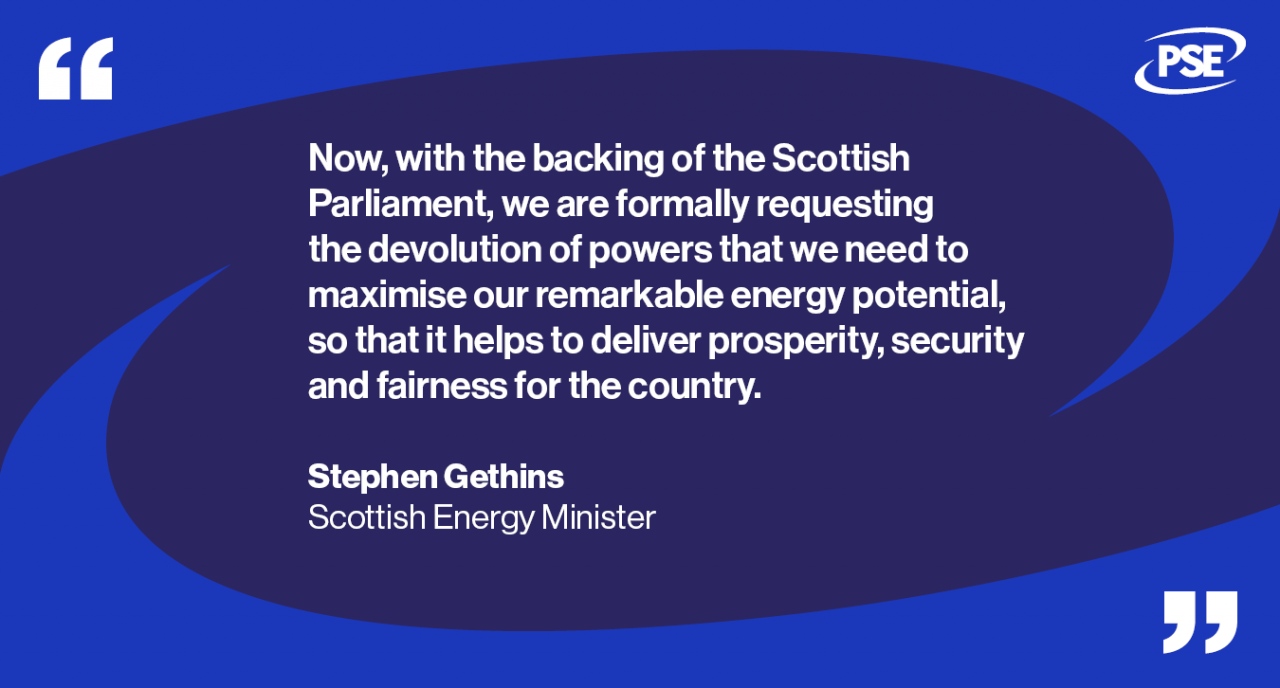
“Now, with the backing of the Scottish Parliament, we are formally requesting the devolution of powers that we need to maximise our remarkable energy potential, so that it helps to deliver prosperity, security and fairness for the country.”
Implications for public sector leaders
For public sector professionals, particularly those involved in energy strategy, infrastructure and procurement, the proposed changes could have wide-reaching implications:
- Policy autonomy: Greater local control could reshape regulatory frameworks and funding models
- Cost management: Potential for region-specific pricing or support mechanisms
- Net zero delivery: Faster alignment between climate targets and energy investment decisions
However, any transition would require detailed negotiation with Westminster, alongside clarity on regulatory frameworks, market structures, and cross-border energy arrangements.
As discussions progress, the debate over energy devolution is likely to remain a key issue – particularly as cost-of-living pressures and net-zero commitments continue to dominate the policy landscape.
Image credit: iStock