

Local authorities across England are facing mounting financial pressure as spending on temporary accommodation continues to spiral, according to new analysis from the Local Government Association.
The data reveals that council expenditure on temporary accommodation has risen by a staggering 1,077 per cent in real terms between 2011/12 and 2024/25, underscoring the growing strain on housing services and wider local government budgets.
Billions spent, with costs accelerating sharply
Over the 13-year period, councils collectively spent £6 billion on temporary accommodation. Alarmingly, more than a third of this total - £2.2 billion (37%) – was spent in just the last two years, 2023/24 and 2024/25.
The findings highlight how the issue has intensified nationwide. While London continues to account for the largest share of spending, other regions are seeing increasingly rapid rises, albeit from lower starting points.
Financial pressure spreading across council services
Temporary accommodation is proving to be a significant and growing burden for councils, as rising homelessness demand forces local authorities to stretch limited budgets even further.
A key issue is the mismatch between rising costs and central government reimbursement. While households receive their full housing benefit entitlement, councils can only reclaim costs from the Department for Work and Pensions at up to 90% of Local Housing Allowance rates set back in 2011.
This gap means councils are absorbing increasing financial losses, which in turn impacts funding available for other critical services.
Call for urgent reform as new Prime Minister takes office
With a new Prime Minister expected to enter office, the LGA is urging immediate action to stabilise council finances and address the root causes of homelessness.
It is calling for the subsidy rate for temporary accommodation to be uprated to reflect current market conditions – specifically, to 90% of prevailing LHA rates.
Alongside this, the LGA has published a new Homelessness Position Paper, outlining a comprehensive plan to tackle the crisis.
Key proposals to tackle homelessness
The LGA’s recommendations focus on four core areas:
- Creating accountability: Ensuring all stakeholders are incentivised and held accountable for preventing homelessness, supported by cross-departmental targets.
- Ensuring deliverability: Aligning resources with prevention goals, including:
- Increased government support for rising temporary accommodation costs
- Uprating subsidy rates to reflect current LHA levels
- Ensuring LHA rates track at least the lowest 30% of rents, alongside reviewing the shared accommodation rate and benefit cap
- Fostering collaboration: Strengthening partnerships between local government, central government and the voluntary sector
- Driving evidence-based policy: Scaling proven interventions and encouraging innovation through rigorous evaluation
Cllr Eamonn O’Brien, Chair of the LGA, said:
“Temporary accommodation is a huge leak in council budgets that needs to be patched quickly and, at its heart, transform the lives of families and children across the country.
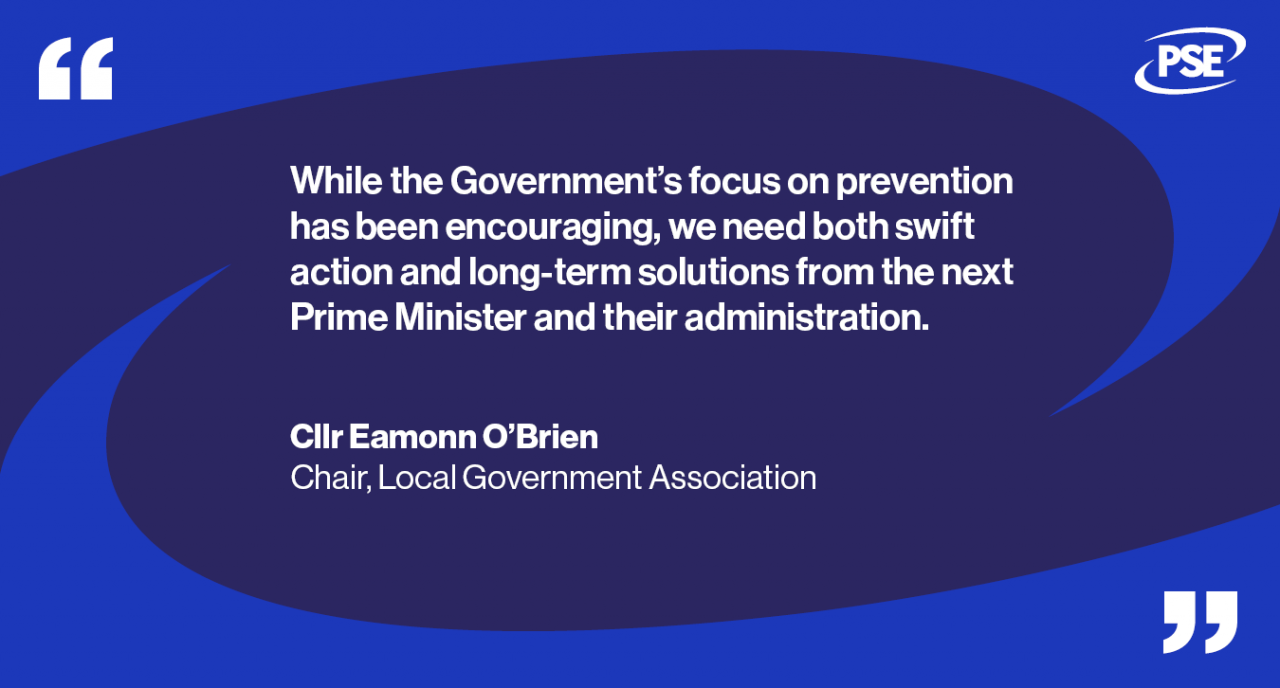
“While the Government’s focus on prevention has been encouraging, we need both swift action and long-term solutions from the next Prime Minister and their administration.
“The way that councils are reimbursed by central government is not working, and it’s impacting the entire country due to the knock-on effect on budgets and all other services.
“The increasing use of temporary accommodation is not only financially unsustainable for councils but is hugely disruptive for individuals and families placed in them.
“Ensuring there are sufficient homes for people is the foundation for strong communities – as our plan to tackle homelessness shows, councils are a key player in this effort and we look forward to working with the government towards this goal.”
Long-term challenge requires structural change
The LGA’s analysis reinforces growing concern across the public sector that without structural reform, including housing supply, welfare alignment and prevention funding, councils will struggle to manage rising homelessness demand.
For local authority leaders and housing professionals, the message is clear: tackling the temporary accommodation crisis will require both immediate financial relief and sustained, systemic change.
Image credit: iStock