

A significant overhaul of local government structures in England is now firmly underway, with ministers confirming a new phase of reorganisation that will reshape how services are delivered across 14 areas.
Announced on 16 July, the plans will see the removal of two-tier systems in parts of the country, replacing them with streamlined unitary authorities. Areas affected include Kent and Medway, Hertfordshire, and Nottinghamshire, alongside several others spanning the Midlands, South West, and South East.
The reform agenda aims to simplify governance, cut duplication, and unlock economic growth by creating larger, more strategic councils with broader powers.
A Shift Towards Simpler, Stronger Councils
At the heart of the programme is the consolidation of 134 councils into just 38 unitary authorities. The Government argues this will eliminate overlapping responsibilities between county and district councils, making services more coherent and easier to access.
Instead of multiple departments across different tiers, residents will deal with a single council structure. This includes:
- One planning service
- One finance department
- A unified leadership team
The intended outcome is both financial efficiency and improved service delivery, with savings redirected into frontline priorities such as highways maintenance and adult social care.
Steve Reed, Secretary of State for Housing, Communities and Local Government, said:
“We’re shaking up local government so that people get the services they deserve - cleaner streets, better care, and money spent on what matters most to local people.
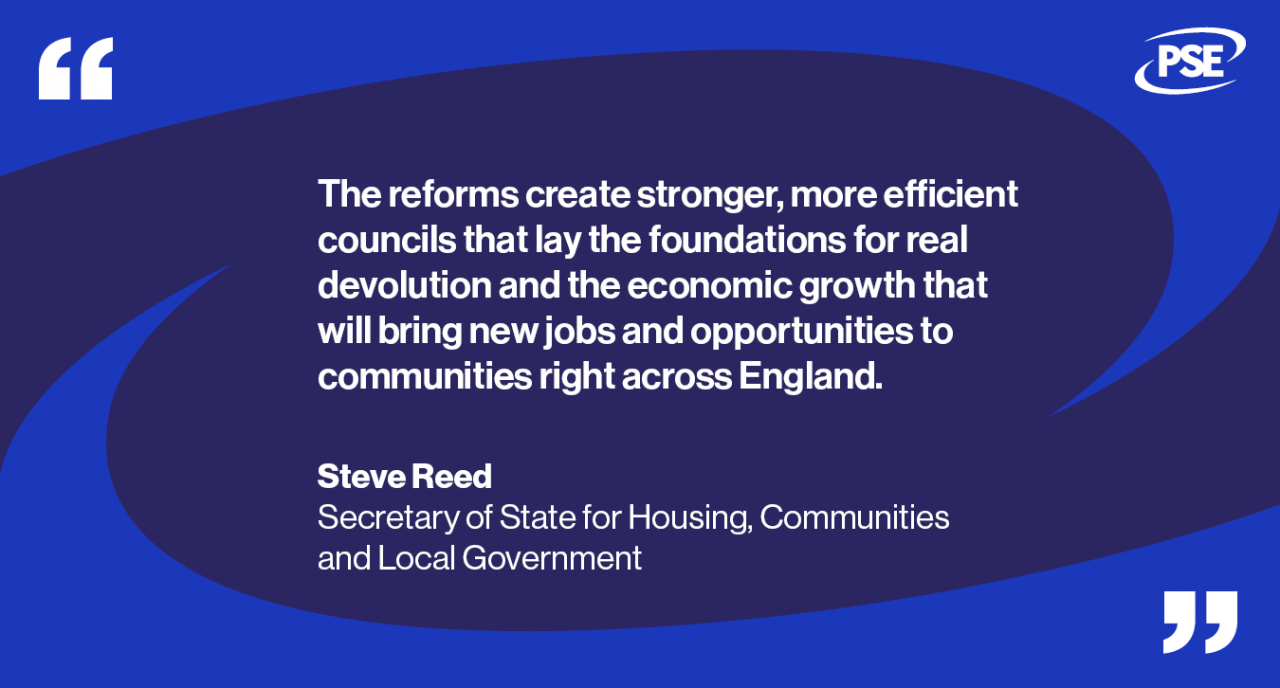
“The reforms create stronger, more efficient councils that lay the foundations for real devolution and the economic growth that will bring new jobs and opportunities to communities right across England.”
Driving Growth Through Devolution
The changes are closely linked to the Government’s wider devolution strategy. By creating larger, more resilient authorities, ministers say local leaders will be better equipped to take on additional powers and deliver long-term growth strategies.
Cities such as Preston, Leicester and Exeter are expected to benefit from enhanced decision-making powers, with reforms tailored to local economic and geographic conditions.
Examples include:
- Boundary updates in Exeter, unchanged since 1966
- Expansion aligned to housing need in Leicester
- Infrastructure and industrial support in Derby
The reorganisation varies by region, but all proposals aim to strike a balance between scale and local identity.
Decisions on West Sussex, Cambridgeshire, and Peterborough are still pending as ministers review final options.
Strategic Impact for Public Sector Leaders
For senior professionals across local government and partner organisations, this reform has far-reaching implications:
1. Workforce Transformation
Restructuring will reshape senior leadership, service teams, and governance frameworks, likely reducing duplication while increasing strategic capacity.
2. Financial Realignment
Savings from streamlined operations are expected, though transition costs and integration challenges will need careful management.
3. Service Integration
Opportunities to better align housing, transport, planning, and social care under a single authority may improve outcomes, but also require robust change leadership.
4. Stronger Regional Voice
Larger authorities will have a more influential role in negotiating funding and powers under future devolution deals.
A Long-Term Reform Agenda
The Government has positioned Local Government Reorganisation as an ongoing programme rather than a one-off change. The overarching goal is to reduce bureaucracy, eliminate fragmentation, and create councils that better reflect how people live and work.
Whether these reforms deliver the promised efficiencies and growth will depend heavily on execution at local level – particularly around leadership, engagement, and service continuity.
Image credit: iStock