


The Welsh Government has announced a £15 million funding package aimed at extending free school meal (FSM) provision to more secondary school pupils, marking the first phase of a wider commitment to remove income barriers for families receiving Universal Credit.
Under current rules, secondary school pupils are only eligible for free school meals if their household income is below £7,400 per year (excluding benefits). The proposed reforms will remove this earnings threshold, making all secondary pupils in households on Universal Credit eligible for support.
The £15 million allocation forms part of the Welsh Government’s 2026–2027 supplementary budget and is designed to support both infrastructure and delivery:
- £10 million in capital funding will be used to upgrade school kitchens and dining facilities.
- £5 million in revenue funding will support the operational rollout of the expanded scheme.
From September 2026, parents of pupils in Years 7 and 8 are expected to be able to apply for the revised scheme, with further expansion anticipated in subsequent phases.
The move builds on the Welsh Government’s earlier policy – delivered through its co-operation agreement with Plaid Cymru between 2021 and 2024 – which introduced universal free school meals for all primary school children across Wales.
The expansion into secondary education reflects a broader strategy to tackle child poverty, improve educational outcomes and support family finances during the cost-of-living pressures affecting households across the UK.
Cabinet Minister for Education and Welsh Language, Anna Brychan, emphasised the policy’s role in supporting both academic performance and pupil wellbeing:
“This funding marks the first step in our commitment to extend free school meals to more secondary pupils, ensuring that support reaches families who need it most. By starting to invest, we are laying the foundations for a fair and sustainable expansion that will make a real difference in pupils’ daily lives.
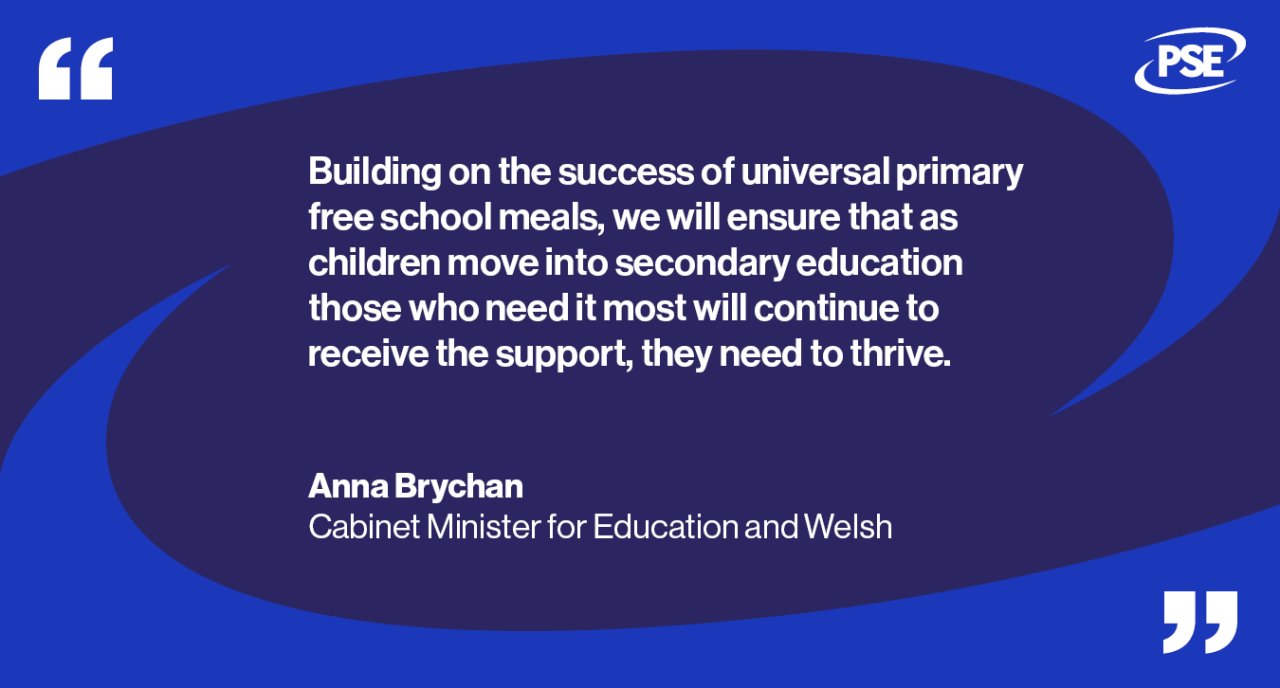
“This work is about removing barriers to learning and supporting wellbeing. We know that access to nutritious food improves concentration, attainment and overall health. Building on the success of universal primary free school meals, we will ensure that as children move into secondary education those who need it most will continue to receive the support, they need to thrive.
“We are working with partners on plans to deliver this effectively and at pace ensuring every pound delivers the greatest possible benefit for the people of Wales. Further details will be announced shortly.”
For education leaders, local authorities and school estates teams, the policy signals several immediate priorities:
- Infrastructure readiness: Upgrades to catering facilities will be essential to meet increased demand.
- Operational capacity: Catering staff, supply chains and meal planning will need scaling.
- Policy alignment: Local eligibility systems and communications will need updating ahead of the September rollout.
The phased implementation approach also provides an opportunity for councils and trusts to test delivery models before wider expansion across all secondary year groups.
Image credit: iStock