

Liverpool City Region has formally launched its new Anti-Racism Strategy, setting out an ambitious plan to dismantle systemic racism, rebuild trust and recognise the contribution of Black, Asian and Minority Ethnic (BAME) communities across the region.
Unveiled at Liverpool’s iconic Liver Building, the strategy represents a significant milestone for the Combined Authority. It has been co-created with more than 200 organisations and over 500 individuals, spanning community groups, public services, educators, grassroots activists, businesses, and residents from every borough.
The initiative is closely aligned with the ongoing work of the £2.3 million Liverpool City Region Race Equality Hub, which was also showcased at the launch event.
The strategy outlines a shared vision built around five core priorities:
- Challenging and dismantling systemic racism across public services, education, employment, and community life
- Strengthening trust and transparency between institutions and Black, Asian and Minority Ethnic communities
- Amplifying lived experience to ensure communities remain central to decision-making
- Supporting organisations to take practical, measurable action on inclusion
- Celebrating the cultural, social, and economic contributions of diverse communities
Steve Rotheram, Mayor of the Liverpool City Region, emphasised the importance of collective action:
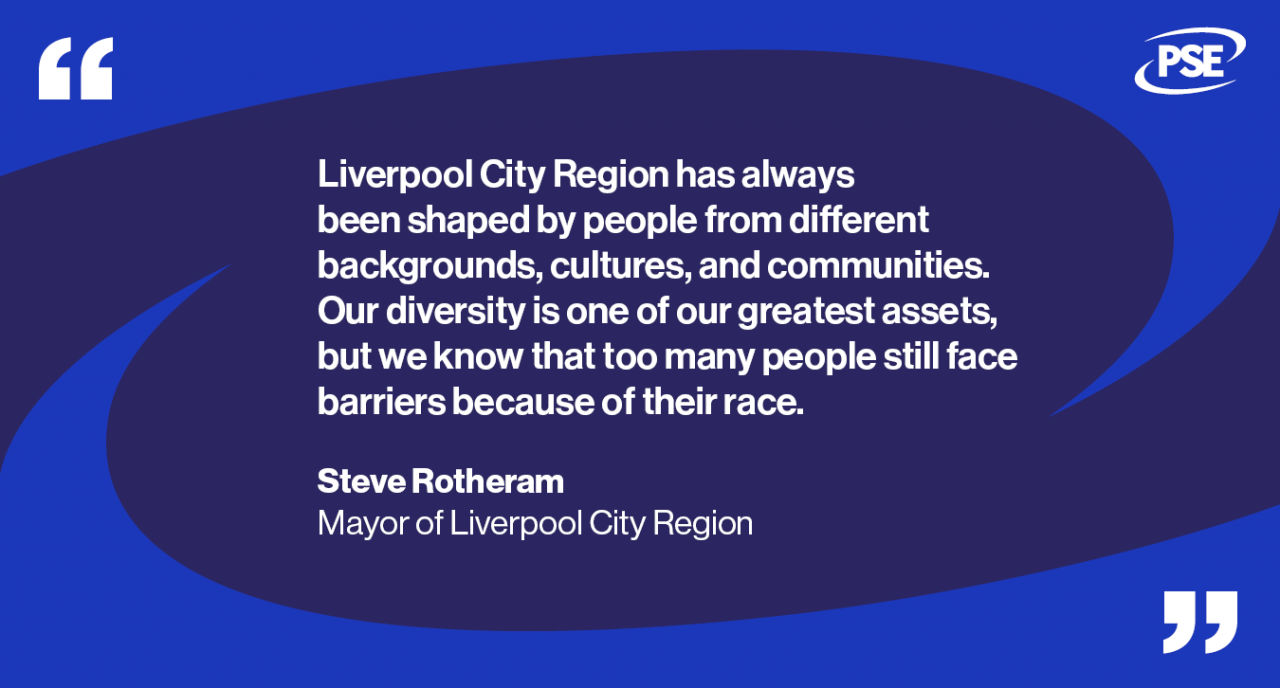
“Liverpool City Region has always been shaped by people from different backgrounds, cultures, and communities. Our diversity is one of our greatest assets, but we know that too many people still face barriers because of their race.
"That's why this strategy exists. It’s not about warm words or good intentions. It’s about bringing people back together around a shared commitment to tackle racism, open up opportunity and make sure everyone can fulfil their potential.
“But this can’t be delivered by the Combined Authority alone. It will take leadership from businesses, public services, community organisations, and residents right across our city region. If we’re prepared to work together, I believe we can build a region where anti-racism isn’t just something we talk about, it’s something tangible that people see and feel in their everyday lives.”
A key feature of the strategy is its governance model, aimed at ensuring delivery is both transparent and accountable over the long term.
The Liverpool City Region Leadership Forum, made up of more than 50 leaders from the public, private, voluntary, community and faith sectors, will act as custodian of the strategy. Its responsibilities include:
- Overseeing delivery and ensuring alignment with the strategy’s priorities
- Championing anti-racism across leadership and decision-making structures
- Monitoring progress and holding organisations to account through evidence-based reviews
- Ensuring community voices remain central to implementation
To reinforce this, a dedicated Reference Group – comprising individuals and organisations that helped shape the strategy – will provide ongoing challenge and insight, ensuring delivery stays grounded in lived experience and emerging issues.
The strategy builds on the early success of the Liverpool City Region Race Equality Hub, launched in March 2024 to support economic advancement among Black, Asian and Minority Ethnic communities.
To date, the Hub has:
- Engaged around 800 individuals and 45 employers through employment-focused events
- Reached more than 1,000 people and 250 organisations via workshops and roundtables
- Supported leadership development involving 40 organisations and 170 participants
- Connected over 100 businesses with potential investors
Alison Navarro, Programme Director of the Race Equality Hub, highlighted the importance of sustained effort and accountability:
“This is a momentous day as we publicly launch the Liverpool City Region’s first Anti-Racism Strategy.
“This has been a huge collective effort and I want to thank everyone – individuals and organisations – who created this strategy with us, particularly the Black, Asian and Minority Ethnic community members who shared their lived and professional expertise.
“We know that previous attempts to tackle racial inequality have failed but I am hopeful that accountability and momentum, building on the skills, knowledge, and experience of Black, Asian and Minority Ethnic communities will be key to the success of this strategy.
“The strategy provides a framework setting out what we need to do to tackle racism. Leaders from across our Region must now create their own approaches introducing proactive anti-racist action within their own organisations.”
For public sector leaders and professionals, the Liverpool City Region’s approach offers a comprehensive model for embedding anti-racism into governance, service delivery, and economic development.
The emphasis on co-creation, measurable outcomes and community-led accountability may prove particularly relevant for organisations across the UK seeking to move from policy commitments to tangible change.
Image credit: iStock