


The government has set out plans for a sweeping overhaul of post-16 education, promising a “new deal for young people” aimed at widening routes into skilled work and curbing the growth of university courses that fail to deliver strong outcomes.
At the heart of the reforms is a shift away from what ministers describe as a “degree by default” culture, with increased investment in apprenticeships and stronger oversight of higher education provision. The move is designed to give young people clearer, higher-quality choices between academic and vocational pathways, while tackling youth unemployment and skills gaps across the economy.
Cracking down on poor-quality degrees
Ministers argue that too many students are being funnelled into courses that offer limited career prospects, often leaving them with significant debt and little improvement in earning potential. Under new proposals, legislation is being explored to limit the expansion of courses with consistently poor outcomes.
The Office for Students (OfS), alongside UCAS and sector partners, will play a greater role in improving transparency. Prospective students will have easier access to information on course performance, including wage returns and employment prospects.
There will also be tighter regulation of franchised provision. Providers with 300 or more franchised students will be required to register with the OfS or risk losing access to student loan funding—an attempt to address concerns about quality and accountability in rapidly expanding parts of the sector.
Rebalancing funding towards apprenticeships
A key pillar of the “new deal” is a major reallocation of funding towards apprenticeships, with a view to reversing a long-term decline in participation among younger people. The government has committed £3.3bn to apprenticeships in the current year and aims to deliver 50,000 additional starts for young people by 2029.
This comes after a 40% fall in apprenticeship starts among 16–24-year-olds over the past decade. Ministers hope that redirecting funding away from programmes largely used by older employees and towards entry-level opportunities will help rebuild the early career ladder.
New foundation apprenticeships, targeted exclusively at young people, are being expanded into sectors such as hospitality and retail, offering more accessible routes from education into sustained employment.
Skills England has also been tasked with reviewing apprenticeship funding rates, particularly for standards most commonly used by younger learners. A report is expected in the autumn, with potential changes aimed at further prioritising early-career training.
Supporting social mobility and opportunity
The reforms are framed as part of a broader ambition to ensure that two-thirds of young people engage in higher-level learning – whether through university, technical education or apprenticeships.
Targeted maintenance grants are set to be reintroduced from the 2028/29 academic year for students from low-income backgrounds studying priority subjects, in an effort to improve access while ensuring value for money.
The plans also sit alongside the government’s wider “Youth Guarantee”, which promises employment, education or training opportunities for all young people. This includes subsidised job placements, incentives for employers to recruit young people who are out of work, and reforms to the Growth and Skills Levy – collectively expected to generate up to 500,000 opportunities.
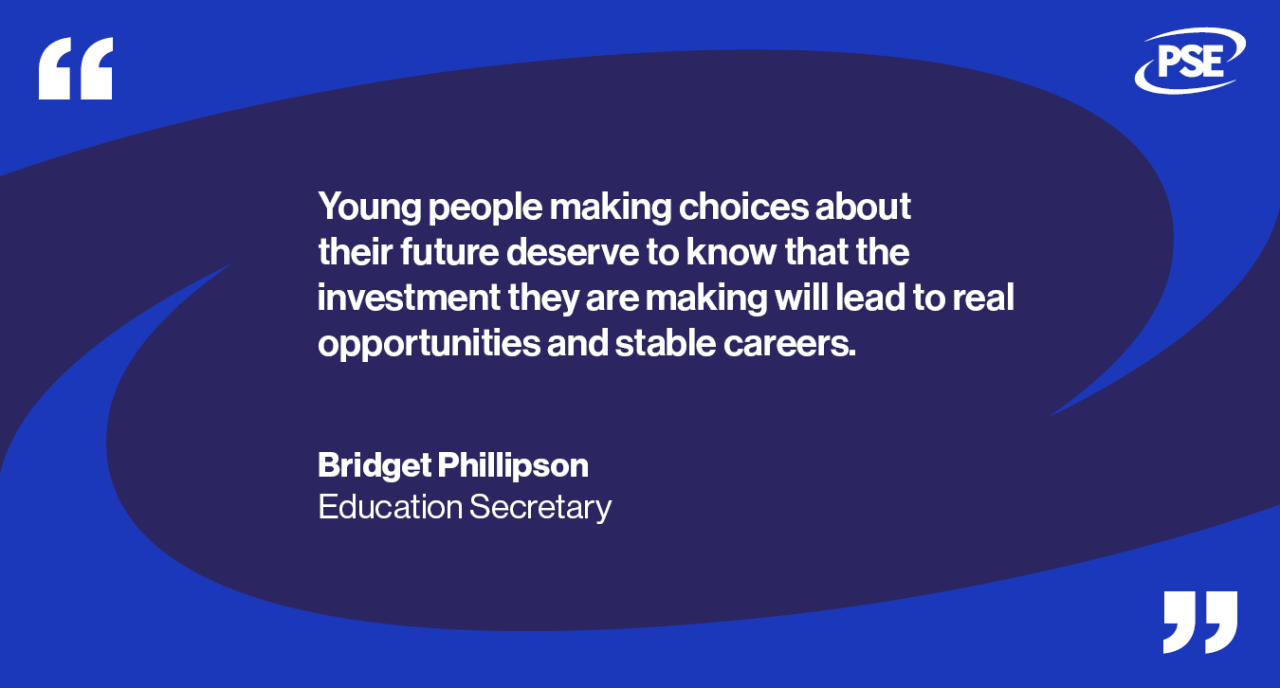
Education Secretary Bridget Phillipson said:
“Young people making choices about their future deserve to know that the investment they are making will lead to real opportunities and stable careers. For some that will mean going to university, and we are making this more accessible regardless of background, but for others it will mean technical or vocational routes.
“By raising standards and cracking down on abuse of student loans we’ll ensure our world-leading universities deliver real value for students and the taxpayer.”
A shift in the social contract
Ministers say the reforms represent a decisive break from previous approaches, acknowledging that the labour market has changed while education pathways have not kept pace.
Citing findings from Alan Milburn’s report, including that around one in seven young people not in education, employment or training holds a degree, the government argues that the system must evolve to deliver better outcomes.
Taken together, the measures aim to reset the “social contract”, ensuring that hard work – whether through academic or vocational routes – translates into tangible career opportunities, fair pay and long-term stability.
Image credit: iStock