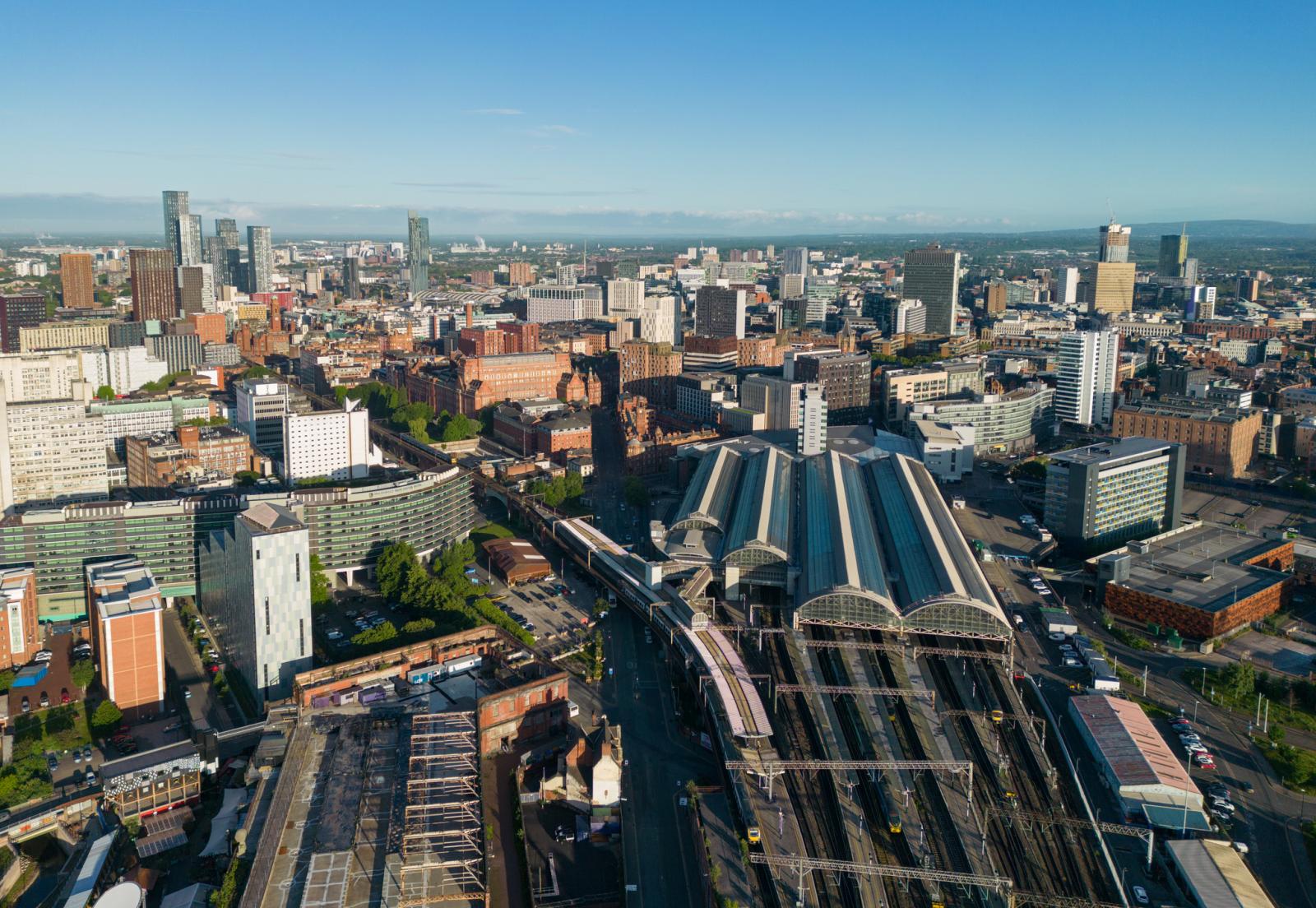

Manchester is already one of the UK’s fastest‑growing and most economically dynamic cities, and new plans centred on the Manchester Piccadilly area set out one of the most ambitious regeneration and transport‑led growth opportunities in the country.
According to a new outline of the city’s long‑term development potential, Manchester contributes over £28bn in GVA annually, achieving an average of 3.4% yearly growth since 2000, which is around double the national rate. This performance is underpinned by a diverse, resilient economy that now includes the largest professional and business services sector outside London, Europe’s largest fintech cluster valued at £5bn per year, and a globally recognised innovation ecosystem spanning AI, data science, advanced materials and health innovation. The city is also one of the UK’s strongest locations for foreign direct investment, with 80 FTSE 100 companies and 50 international banks choosing to establish operations there.
Talent remains one of Manchester’s core competitive strengths. The city is consistently ranked among the world’s top student destinations, and nearly half of its graduates stay after completing their studies, feeding a pipeline of skills into its rapidly growing sectors. With the extended city centre now home to 250,000 jobs and 80,000 residents, employment growth continues to run at over 4% per year, outpacing most major UK urban centres.
The next phase of the city’s expansion is set to be anchored around a 150‑hectare growth area spanning north–south of Piccadilly, west toward the Oxford Road Corridor, and east toward Mayfield, the Manchester Digital Campus, Ardwick and East Village Central. Its position, where national rail, regional transport, Metrolink and innovation districts converge, makes it one of the most strategically located regeneration zones in the UK.
The development potential is vast. The Piccadilly area could deliver:
- Up to 40,000 new jobs
- Around 13,000 new homes
- Close to 1 million m² of Grade‑A commercial floorspace
In scale and ambition, the programme is likened to international regeneration exemplars such as King’s Cross (London), Hudson Yards (New York), and Antwerpen Centraal.
This strategic zone is shaped by a series of interconnected character areas:
- Piccadilly Central – A major commercial district immediately north of the station, designed to drive job creation and attract high‑value occupiers.
- Sister – A mixed‑use employment‑led regeneration area with strong life‑sciences and innovation potential.
- Mayfield – A flagship mixed‑use district centred around a new public park.
- Manchester Digital Campus – A sustainability‑focused office district designed for the digital sector.
- Ardwick – A key eastward expansion zone with significant residential development opportunities.
- Piccadilly Basin, Portugal Street East, and East Village Central – Mixed‑use and residential neighbourhoods expanding connectivity and linking the station district to emerging communities across east Manchester.
- Oxford Road Station Area – A major opportunity to reshape the public realm and create a high‑quality destination at the edge of the prolific Oxford Road Corridor.
At the centre of this vision lies a project of national significance: Northern Powerhouse Rail. As part of the Government’s wider Northern Growth Strategy, NPR would place Manchester Piccadilly at the heart of a new east‑west rail network connecting the key cities of Liverpool, Bradford, Leeds, Sheffield and York, with onward links to the North East, Hull and North Wales.
NPR is conceived as a transformational economic corridor. Its aims include:
- Expanding labour markets across the North
- Improving journey times and reliability
- Increasing passenger and freight capacity
- Rebalancing the UK economy by creating a single connected northern economic system
A central component is the proposal for an underground through‑station at Manchester Piccadilly. By placing NPR infrastructure below ground, the city can unlock above‑ground land for high‑value development, while providing the long‑term transport capacity expected of a global city.
Local leaders argue that without an underground station, land constraints, surface‑level congestion and limited capacity could dramatically restrict Manchester’s ability to grow at the scale projected. The underground model, they say, is essential for unlocking billions in economic value.
Taken together, the Piccadilly growth framework and the NPR proposals represent one of the largest coordinated regeneration and transport investment opportunities anywhere in the UK. Manchester’s trajectory, already defined by innovation, talent and economic diversity, could accelerate significantly if the conditions set out in the new prospectus are realised.
The vision is clear: a globally competitive city centre powered by high‑density commercial development, thousands of new homes, a world‑class rail interchange and an expanded innovation ecosystem stretching from Oxford Road to the city’s eastern edge.
Delivery will require long‑term commitment, integrated planning and sustained collaboration between central government, local authorities, rail bodies and industry. But if brought forward in full, Manchester Piccadilly could become one of the most important growth engines in the country, reshaping not just Greater Manchester but the economic geography of the entire North.
Image credit: iStock