
Families and businesses across the UK are set to benefit from a strengthened push towards clean energy, after the government confirmed a new emissions target designed to shield households from rising costs, boost economic growth and address the climate crisis.
The announcement, made on Tuesday 2 June, sets out the proposed level for the UK’s Seventh Carbon Budget, targeting an 87% reduction in emissions between 2038 and 2042. The target has been endorsed by both the Environmental Audit Committee and the Climate Change Committee, reinforcing its scientific credibility and alignment with long-term national climate goals.
Breaking reliance on volatile fossil fuel markets
The move comes at a time when the UK is facing its second fossil fuel price shock in five years, linked to global instability including the ongoing conflict involving Iran. Ministers argue that accelerating the transition to clean, home-grown energy is central to improving financial resilience for households and businesses.
By shifting away from reliance on international fossil fuel markets, the government believes it can protect the UK economy from the volatility seen following events such as Russia’s invasion of Ukraine and the current geopolitical tensions.
Net zero economy already delivering jobs and growth
New analysis published alongside the announcement highlights the scale of the economic opportunity. A report from the Energy and Climate Intelligence Unit, supported by CBI Economics, shows that the net zero economy now supports over one million jobs and contributed £105 billion in gross value added (GVA) in 2025.
This puts the sector among the fastest-growing parts of the UK economy, with higher-than-average productivity and wages. According to the data, net zero jobs are 48% more productive than the UK average, generating £119,300 per role, with average salaries of £43,142.
Technology and consumer choice at the heart of the plan
The new carbon budget is underpinned by a consumer-led approach to adopting technologies such as solar panels, battery storage and electric vehicles (EVs). Ministers say these technologies not only support decarbonisation but also offer direct cost savings to households.
- Households installing solar panels could save up to £500 per year
- EV drivers could save as much as £1,400 annually on running costs
- New electric cars are now, on average, cheaper to buy than petrol equivalents
The government’s planned £15 billion Warm Homes Plan is also expected to play a central role, delivering large-scale home upgrades aimed at reducing energy bills and tackling fuel poverty.
Investment and energy security priorities
The UK has already seen more than £90 billion in private investment in clean energy since July 2024, including major carbon capture projects in Teesside and the development of nuclear power at Sizewell C.
Looking ahead, the government expects clean energy expansion to significantly reduce the country’s dependence on fossil fuels—from around 75% of current energy use to approximately 15% by 2050. This shift could also avoid an estimated £445 billion in fossil fuel spending over the next 25 years.
Recent renewable energy auctions have secured enough capacity to power the equivalent of 23 million homes, underlining the pace of deployment.
Health, environment and public sector impact
Beyond economic benefits, the transition is expected to deliver substantial public health gains. Cleaner air resulting from reduced emissions could lead to around 8,000 fewer hospital admissions each year by 2050, easing pressure on the NHS.
Nature recovery is also a central element of the strategy. Programmes such as peatland restoration and woodland creation are projected to generate £50 billion in environmental benefits, including improved biodiversity, water quality and flood resilience.
The cost of inaction
The Office for Budget Responsibility has warned that the cost of climate damage is rising, while the cost of transitioning to net zero continues to fall. Without action, risks include threats to food and water security, infrastructure resilience and national security, alongside growing global instability.
Energy Secretary Ed Miliband said:
“As Britain faces the second fossil fuel shock of the decade, the only way to protect family and business finances is to drive for clean homegrown power that we control.
“What has been achieved so far by businesses and communities across the country is a great British success story - cutting costs by upgrading homes, backing British businesses, supporting one million good jobs according to new analysis from CBI Economics, and protecting our beautiful countryside.
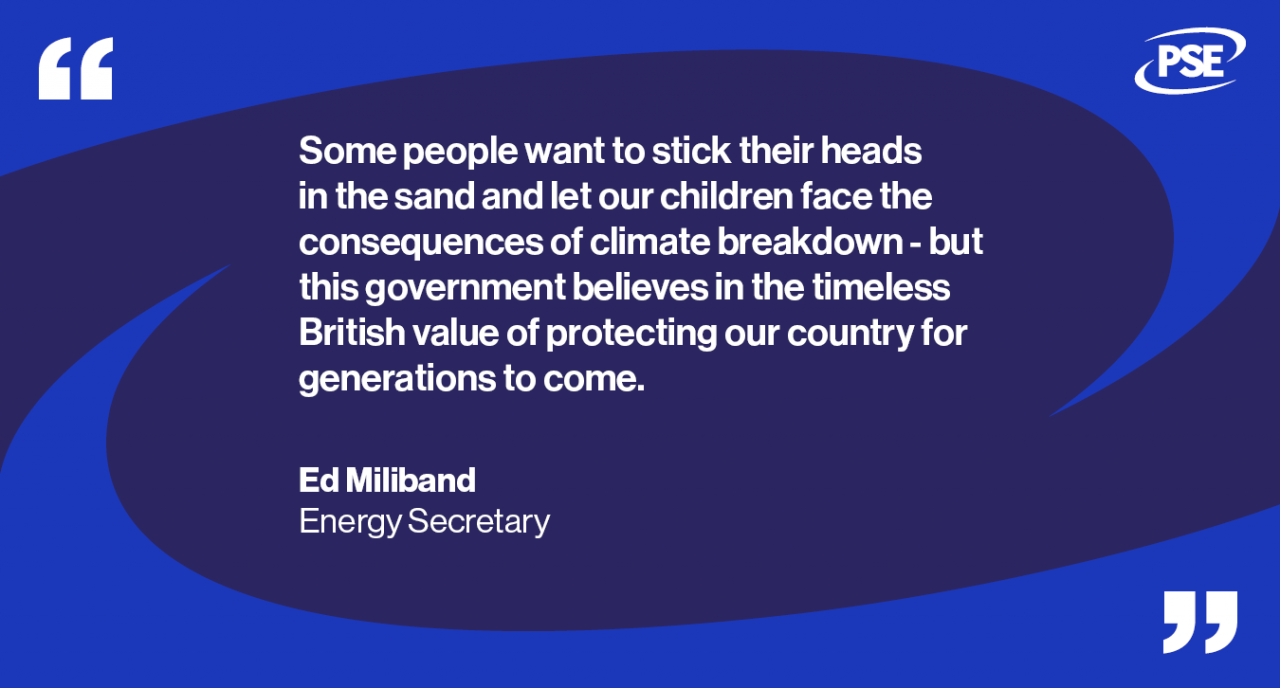
“Some people want to stick their heads in the sand and let our children face the consequences of climate breakdown - but this government believes in the timeless British value of protecting our country for generations to come.”
A full delivery plan outlining how Carbon Budget 7 will be achieved will be published following parliamentary approval. Ministers say setting the target now provides long-term policy certainty, encouraging investment and supporting sustained economic growth.
Image credit: iStock