

A new three-year strategy to transform skills provision across Cambridgeshire and Peterborough has been unveiled, setting out how the region intends to build the workforce required to double, ultimately treble, its economy by 2050.
Published by the Cambridgeshire Chamber of Commerce alongside the Cambridgeshire and Peterborough Combined Authority, the refreshed Local Skills Improvement Plan (LSIP) 2026–2029 draws on one of the most comprehensive local evidence bases assembled in England. The plan is informed by 341 employer survey responses, 70 in-depth interviews, and continuous labour market intelligence gathered since 2023.
Closing the Economic Divide
A central priority is addressing stark regional inequalities. While Cambridge and South Cambridgeshire outperform national averages on productivity, parts of the north – particularly Fenland – lag significantly behind. The district is currently 25% below the productivity benchmark and ranks as the most education-deprived local authority in England.
Across the wider region, nearly 80,000 adults are not engaged in education or employment, with around two-thirds based in northern areas. The plan sets out targeted interventions to tackle this imbalance and boost participation.
Addressing Critical Workforce Shortages
The LSIP identifies acute recruitment and skills gaps in several sectors critical to public service delivery and economic resilience. These include:
- Health and social care
- Education and teaching
- Construction trades
- Engineering and manufacturing
A key concern is the 26% drop in engineering and manufacturing apprenticeships since 2018/19. Reversing this trend is seen as essential to maintaining core infrastructure and service capacity.
At the same time, the region faces a significant demographic challenge. Around 86% of future workforce demand will come from replacement need, with nearly 295,700 additional workers required by 2035 to offset retirements. Roles in care, transport, agriculture and entry-level occupations are expected to face the greatest pressure.
Responding to Rapid Skills Change
The labour market is evolving at pace. Between 2021 and 2025, nearly half of the region’s top 50 in-demand skills changed, driven largely by advances in digital technology, AI, and the transition to a green economy.
Green job postings are now 33% above their long-term average, with recruitment across energy and clean technology reaching record levels. Despite this, the report highlights a clear gap in practical AI training, with no established local offer focused on real-world business applications.
Employers are also calling for stronger emphasis on transferable skills, particularly communication, critical thinking and problem-solving.
Eight Priorities for Action
In response, the LSIP sets out eight strategic priorities for 2026–2029. These include:
- Expanding access to higher-level and modular education beyond Cambridge
- Growing apprenticeship opportunities for young people
- Increasing Skills Bootcamps
- Strengthening talent pipelines in engineering, electrical and construction trades
- Supporting the “foundational economy” sectors such as care, logistics and education
The plan also aligns workforce development with a pipeline of major regional projects, including Universal Studios, East West Rail and the Fens Reservoir, projects expected to drive long-term employment demand.
Strengthening Careers Guidance and Employer Support
A more coordinated approach to careers advice is also central to the strategy. By embedding real-time labour market intelligence into careers guidance, the plan aims to:
- Raise aspirations in areas with high youth unemployment
- Improve awareness of in-demand jobs
- Increase take-up of existing training provision
Employers – particularly SMEs – will receive practical support to navigate evolving policy changes, including the Growth and Skills Levy, the Employment Rights Bill, and new migration frameworks.
Meanwhile, the CPCA has committed to aligning its devolved adult skills funding and capital investment with the LSIP’s objectives. Progress will be monitored annually by the region’s Skills Board and shared nationally with Skills England.
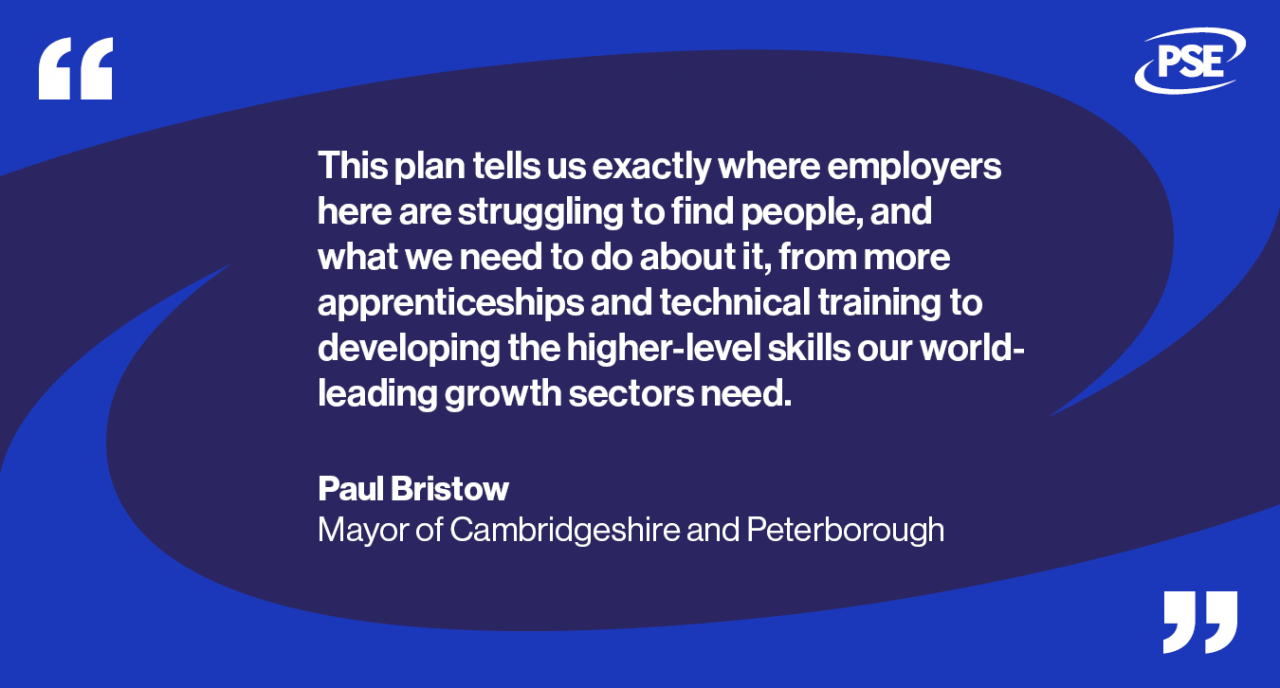
Paul Bristow, Mayor of Cambridgeshire and Peterborough, said of the LSIP:
“To grow our economy, we need a skills system that works for local people and local businesses. This plan tells us exactly where employers here are struggling to find people, and what we need to do about it, from more apprenticeships and technical training to developing the higher-level skills our world-leading growth sectors need.
“I want to bring together employers, colleges and training providers around the same priorities, so that investment in our skills system creates more opportunities for jobs. That means better prospects for local people, businesses with the talent they need to thrive, and an economy that grows because we’ve got the workforce to match it.”
Image credit: iStock