

The government is set to introduce new legislation that could allow British Steel to return to public ownership for the first time since its privatisation in 1988, as part of plans to strengthen the UK’s industrial resilience.
The proposals will be outlined in the King’s Speech, following an announcement by the Prime Minister where he sebrit out a broader strategy to support British industry, protect jobs and enhance national security.
Under the proposed legislation, the government would gain powers to intervene and potentially nationalise British Steel, subject to a public interest test.
This test would consider factors such as:
- National security
- Protection of critical infrastructure
- Economic stability and supply chain resilience
Any decision to bring the company into public ownership would only be taken if these criteria are met and after the legislation receives Royal Assent.
The move follows a period of uncertainty surrounding the future of British Steel.
In April 2025, the government intervened under the Steel Industry (Special Measures) Act to prevent the sudden closure of blast furnaces at the company’s Scunthorpe site, safeguarding thousands of jobs and ensuring continuity of supply.
Since then, ministers have been engaged in discussions with the company’s current owner in an attempt to secure a commercial sale.
The government has confirmed that it has been unable to reach an agreement with the current owner that would deliver acceptable value for taxpayers.
As a result, ministers believe that introducing legislation to enable public ownership is now the most appropriate next step.
Officials stressed that any final decision remains conditional, with the new powers providing a route rather than a guarantee of nationalisation.
If used, the new powers could provide greater stability for workers at the Scunthorpe site, as well as for the wider network of suppliers and customers that rely on British Steel.
The company plays a significant role in the UK’s industrial base, supporting jobs and economic activity across multiple sectors.
Government leaders say ensuring the continuity of domestic steel production is critical to maintaining industrial capability and resilience.
The announcement builds on the government’s Steel Strategy, launched in March 2026, which sets out a long‑term plan to revitalise the UK steel sector.
The strategy aims to:
- Increase domestic steel production
- Meet up to 50% of UK demand from UK‑based sources
- Strengthen supply chains and reduce reliance on imports
Public ownership, if pursued, would be one element of this broader effort to secure the future of the industry.
Ministers have emphasised the importance of steel production to the UK’s national security and sovereign capabilities. Steel is essential for infrastructure, defence, construction and manufacturing, making it a strategically important industry. Ensuring a stable, domestic supply is seen as critical to protecting the UK’s long‑term economic and security interests.
Since the government’s intervention in 2025, British Steel has continued operations at its Scunthorpe site, maintaining production capacity and supporting the local economy. The intervention provided reassurance to employees, suppliers and the wider community while longer‑term solutions were explored.
Prime Minister Keir Starmer said:
“Steel is strategically important to our economy and our national resilience. That’s why we acted last year to avoid a sudden halt to production at Scunthorpe, protecting workers and the community that depend on the site, and why we’re now bringing forward legislation to give us options to protect Britain’s steelmaking capability.
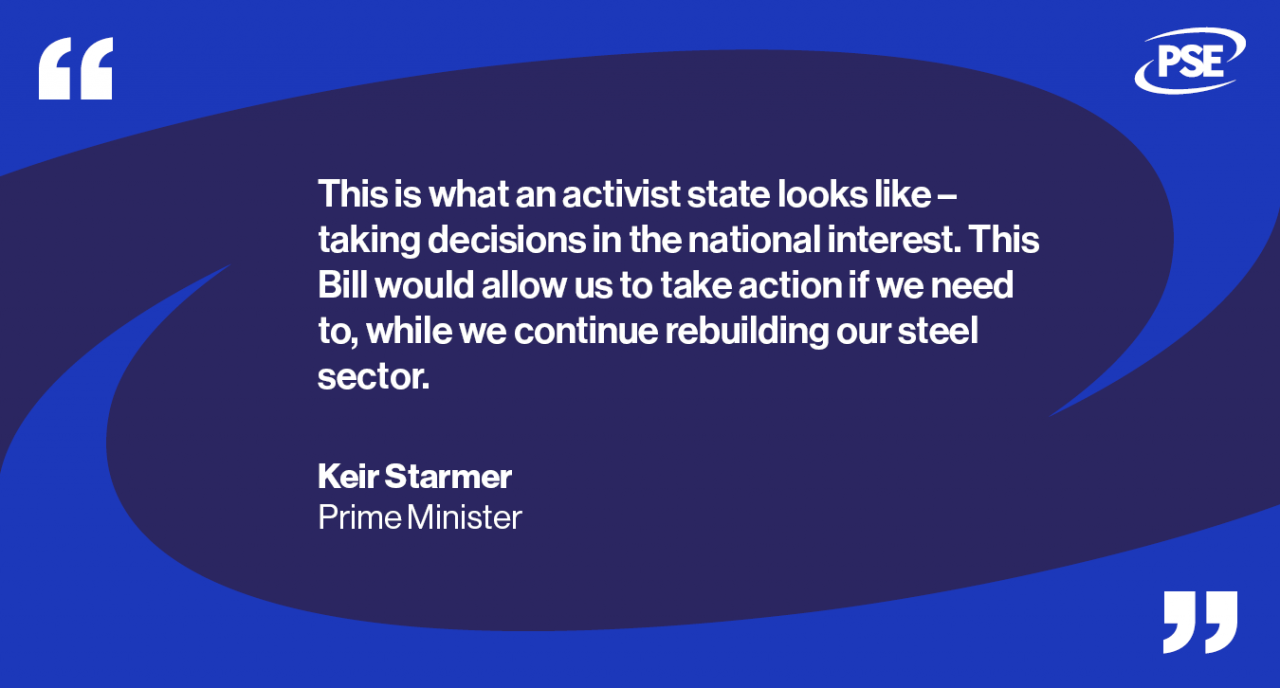
“This is what an activist state looks like – taking decisions in the national interest. This Bill would allow us to take action if we need to, while we continue rebuilding our steel sector.”
The proposed legislation will be formally introduced to Parliament this week, where it will be debated and scrutinised.
Only once the Bill becomes law would ministers have the option to trigger public ownership, and only if the public interest criteria are satisfied. The developments mark a significant moment for the UK steel industry, signalling a potential shift towards greater government involvement in strategic sectors.
Image credit: iStock