


Millions of homeowners across England could soon see significantly quicker decisions on planning applications, as the government unveils two new artificial intelligence tools designed to modernise the system and reduce long-standing delays.
Announced today, the new technologies are aimed at streamlining the processing of householder planning applications – covering common projects such as extensions, loft conversions and home improvements – which currently make up nearly 70% of all planning submissions.
Cutting decision times in half
At the heart of the announcement is a new AI prototype that could reduce average processing times from eight weeks to just four in straightforward cases. The system is already undergoing early-stage testing with Barnet, Camden and Dorset councils.
The prototype works by:
- Triaging incoming applications
- Summarising key documents and details
- Providing an initial assessment for planning officers
Importantly, all final decisions will remain firmly in human hands, with qualified planning officers reviewing and approving every application.
The tool has been developed through a collaboration between government, Google DeepMind, Google Cloud, Faculty and local authorities, marking a significant public-private partnership in planning reform.
‘Extract’ tool rolls out nationwide
Alongside the prototype, the government has confirmed that its ‘Extract’ AI tool is now available to all councils in England, delivering on a commitment made by the Prime Minister last year.
Extract tackles one of the most time-consuming challenges in planning: converting decades-old documents, often containing handwritten notes and complex maps, into usable digital data.
By automating this process, the tool is expected to:
- Save up to 250,000 hours annually across the sector
- Reduce document processing time from over 500 hours to around 255 hours per council
- Improve accessibility and transparency of planning data for both officers and the public
Boosting productivity and housing delivery
With around 350,000 planning applications submitted each year in England, the system has long been criticised for its reliance on outdated, paper-based records. Planning officers often need to sift through hundreds of pages of documentation just to determine applicable local policies.
By digitising information and speeding up routine cases, these AI tools are expected to deliver a “step-change in productivity”, enabling officers to focus on more complex and strategically important developments.
This aligns with the government’s wider ambition to build 1.5 million homes and improve the efficiency of public services through technology.
Minister for Data and Modern Digital Government, Ian Murray, said:
“When someone wants to add a bedroom or convert their loft, they shouldn’t be waiting months for a straightforward decision. And planning officers shouldn’t be spending hours digging through decades of paper records when making the decisions that really matter.
“These tools give planning officers better support to make quicker decisions - and give families the answers they deserve, faster.
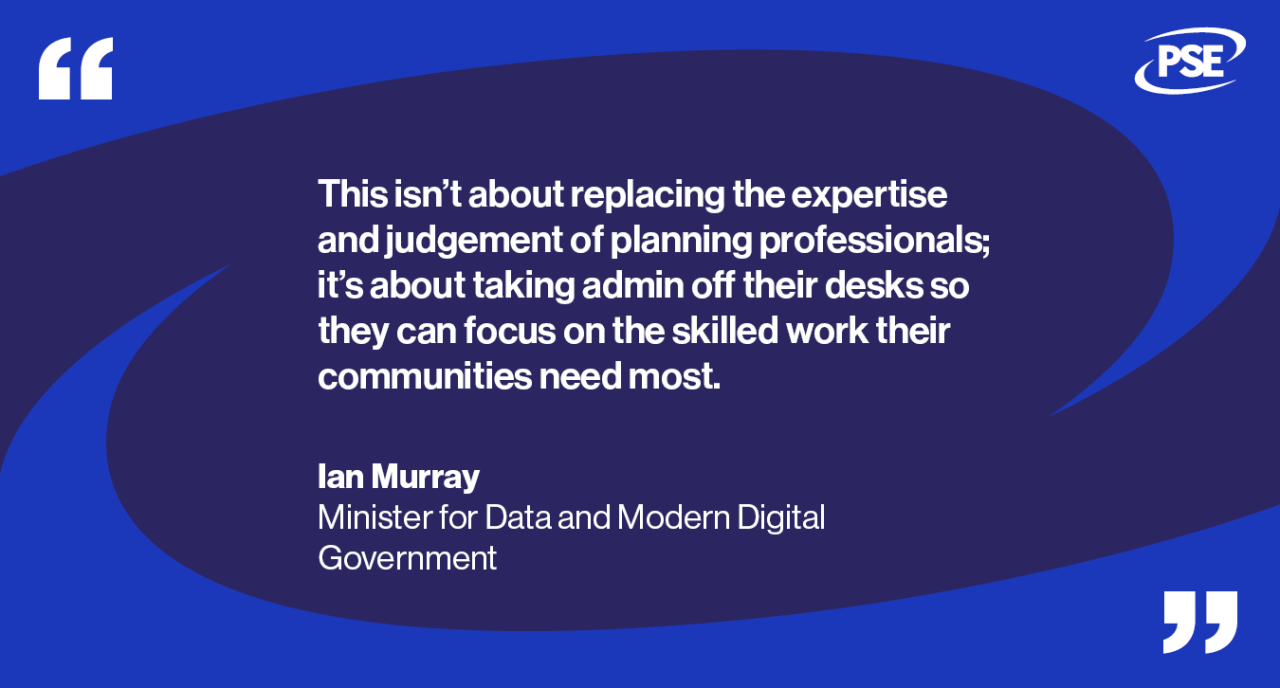
“This isn’t about replacing the expertise and judgement of planning professionals; it’s about taking admin off their desks so they can focus on the skilled work their communities need most.”
Wider planning reforms underway
The announcement comes alongside broader reforms to England’s planning system. Earlier this month, the government introduced new regulations aimed at overhauling planning committees, including a National Scheme of Delegation to fast-track smaller applications such as home extensions.
If the current AI trials prove successful, the government plans to roll out the prototype nationwide by 2027, further embedding digital innovation into the planning process.
The Extract tool itself has been developed by the Incubator for AI (i.AI) in partnership with the Ministry of Housing, Communities and Local Government’s Digital Planning programme, reflecting an increasing focus on applied AI within the public sector.
Image credit: iStock