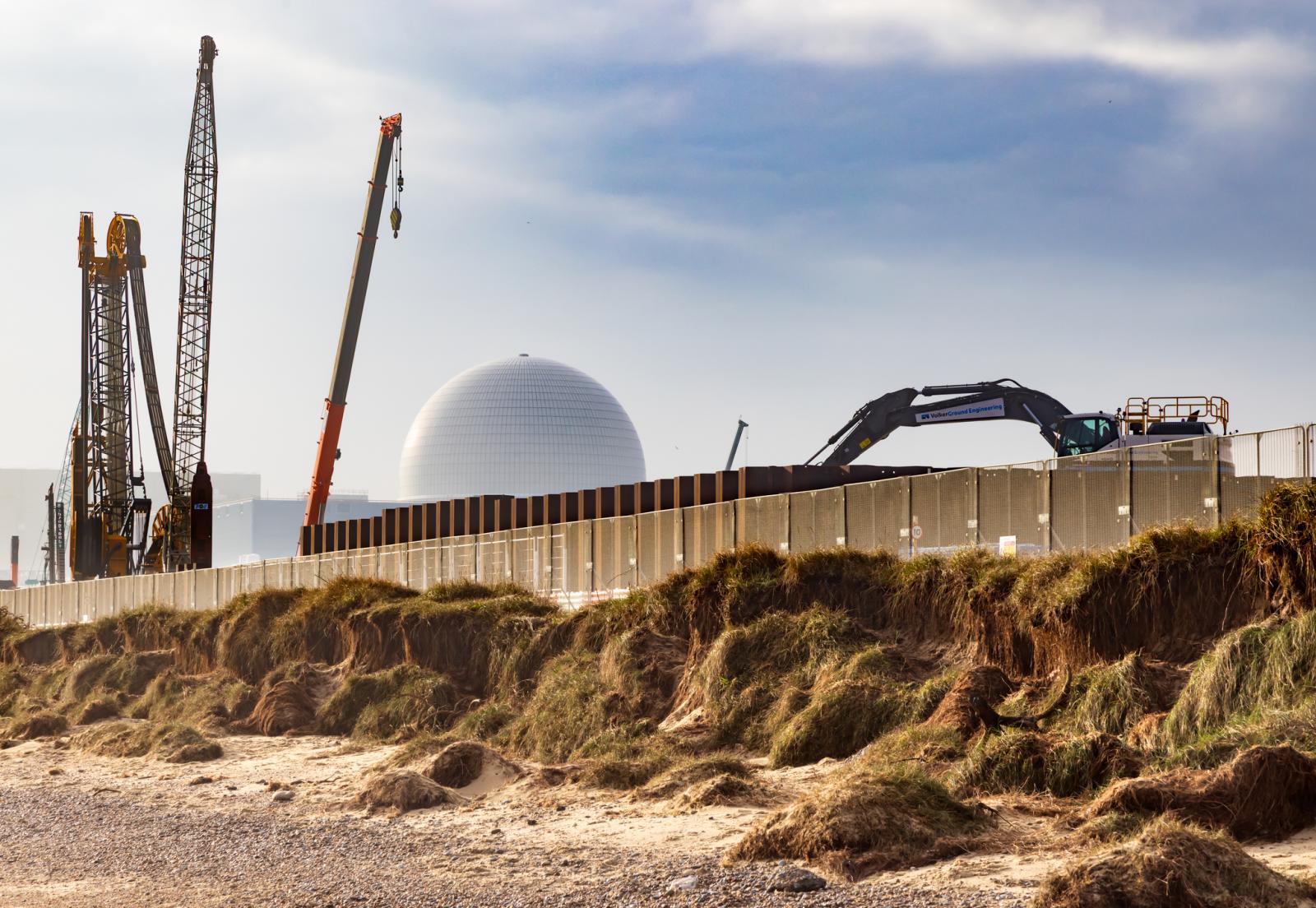

A new report from the National Audit Office (NAO) has concluded that the Department for Energy Security and Net Zero’s (DESNZ) delivery model for Sizewell C places significantly more financial risk on taxpayers and electricity consumers than other major power projects.
While the Department argues that this innovative approach lowers financing costs and improves the chances of delivering the project on time and within budget, the NAO says the model relies on major assumptions and comes with material costs and uncertainties.
Delayed investment decision but clearer cost picture
Following protracted negotiations, DESNZ announced in 2025 that it had secured private investment from Électricité de France (EDF) and other backers. The final investment decision came more than two years later than originally planned, but the delay allowed the project to proceed with a more developed and fully costed construction timetable.
Sizewell C now has a baseline cost estimate of £38.2 billion, with construction expected to be completed by summer 2039. Once operational, the plant could generate enough electricity to power the equivalent of six million UK homes for around 60 years.
Consumers are already paying – with higher costs to come
Under the regulated asset base (RAB) model, consumers began contributing to the cost of Sizewell C from November 2025. DESNZ estimates that electricity bills for a typical household will rise by £4 in 2025–26, increasing to between £17 and £19 a year by the time the plant opens.
DESNZ’s modelling suggests that, once operational, Sizewell C could deliver net consumer benefits of up to £18 billion, largely through lower electricity costs compared with alternative routes to net zero. However, the NAO highlights that these benefits are not expected to outweigh consumer costs until after 2060, and even then, remain subject to substantial uncertainty.
There is also a risk that alternative low‑carbon technologies could prove cheaper or more effective over time, potentially eroding the projected benefits.
Limited government control despite heavy public financing
Although the government has provided the majority of the project’s finance, DESNZ holds only a minority ownership stake in the Sizewell C company. This structure deliberately limits departmental control, which DESNZ argues is necessary to avoid the governance failures seen in previous government‑led mega‑projects.
DESNZ assumes that full public control would push construction costs up to the £47.7 billion ‘higher regulatory threshold’ set out in Sizewell C’s economic licence. The Department believes private investors’ expertise will help contain costs and accelerate delivery.
However, the NAO notes that the financial returns to investors will cost consumers between £4.0 billion and £4.5 billion, unless those investors succeed in reducing costs or shortening the construction timetable by an equivalent amount.
Incentives may not be strong enough
While investors say they are strongly motivated to keep costs below the higher regulatory threshold, the NAO questions how robust the incentives really are. Investor returns fall by up to 1.6 percentage points for cost overruns below the threshold, but if costs rise to just under that limit, investors can still earn returns comparable with other utility investments.
In addition, although investors face normal commercial risks, these are shared with consumers and taxpayers, with limits on both potential gains and losses. The government has also provided a range of contractual commitments designed to support investor confidence.
Learning lessons from Hinkley Point C – but risks remain
Comparisons with Hinkley Point C are unavoidable. That project is now expected to cost roughly double its original estimate and has suffered a seven‑year delay, raising concerns that Sizewell C could face similar challenges.
DESNZ believes it can avoid repeating those mistakes by applying lessons learned and using Hinkley’s finalised designs. As a result, Sizewell C’s plans are significantly more advanced than Hinkley’s were at the same stage.
Even so, while Sizewell C is expected to be cheaper to build, consumers are likely to pay more for its electricity. Hinkley’s strike price was agreed before its cost overruns, which EDF absorbed, and borrowing costs have risen sharply since then.
DESNZ and the Sizewell C company have also committed to new approaches for incentivising contractors, drawing on lessons from other large infrastructure programmes. The NAO says it will closely monitor how effective these measures prove to be.
Gareth Davies, Head of the NAO, said:
“Sizewell C forms a significant part of the government’s plan for a secure and affordable clean energy supply. There has been a concerted attempt to learn from the problems of previous nuclear power construction projects and other large infrastructure schemes. This has resulted in a novel financing structure and DESNZ will need to monitor the risks to taxpayers and billpayers closely.”
Image credit: iStock