
More than 230 knife crime hotspot areas across England and Wales are set to benefit from increased police patrols, enhanced CCTV coverage and targeted prevention programmes as part of a major government-backed crackdown on violent crime.
The initiative, supported by the Home Office, will see 27 police forces work alongside local authorities to deliver tailored interventions aimed at reducing knife crime, protecting communities and preventing young people from becoming involved in violence.
Under the plans, local police forces and councils will implement bespoke strategies based on the specific challenges facing their communities.
Measures include:
- Increased uniformed police patrols in high-risk locations.
- Enhanced CCTV monitoring.
- Early intervention programmes for young people identified as being at risk of either carrying knives or becoming victims of knife crime.
- Environmental improvements such as better street lighting.
- Redesign of public spaces to reduce opportunities for weapons to be concealed.
The expansion reflects growing evidence that concentrated efforts in small geographical areas can significantly reduce serious violence and knife-related offences.
The latest figures suggest that focused enforcement activity is already delivering results in several parts of the country.
Seven police forces, including the Metropolitan Police, West Midlands Police, Greater Manchester Police, West Yorkshire Police, South Yorkshire Police, Avon and Somerset Police, and British Transport Police, have reported notable progress through improved intelligence-sharing and data-led policing.
Across those forces, knife-enabled robbery has fallen by 23% since the General Election, equating to more than 3,600 fewer reported knife robberies.
The government also reports that overall knife crime has decreased by 11% since taking office, supporting its long-term ambition to halve knife crime within the next decade.
Speaking about the expanded programme, Home Secretary Shabana Mahmood said:
“Everyone deserves to feel safe in their community, and no young life should be blighted by knife crime.
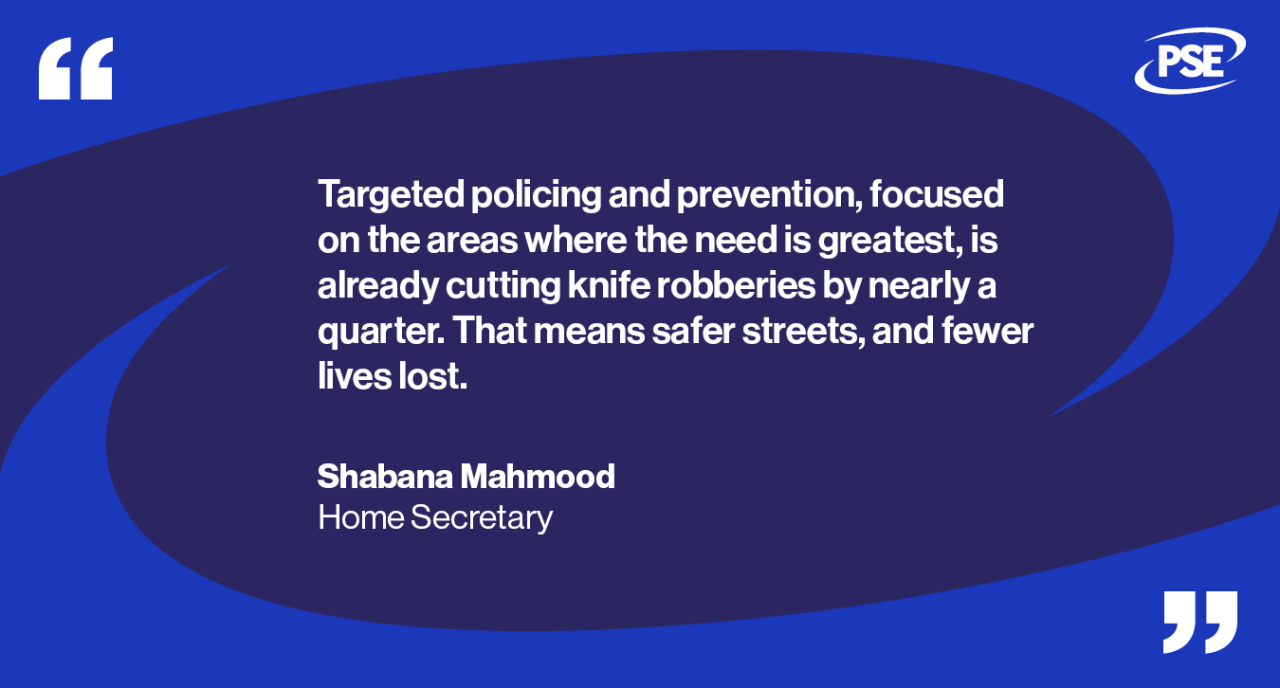
“Targeted policing and prevention, focused on the areas where the need is greatest, is already cutting knife robberies by nearly a quarter. That means safer streets, and fewer lives lost.
“I am now taking this approach to more than 230 areas across the country. This government is getting tough on knife crime and on the causes of knife crime to make our communities safer.”
On 17 September, Shabana Mahmood visited the West Midlands, one of the regions receiving additional funding through the Knife Crime Concentrations Fund.
During the visit, she met community leaders and campaigners at a local boxing gym that provides support and positive opportunities for vulnerable young people. The gym is regarded as an important tool in helping steer young people away from crime and violence.
Joining the visit were members of the Coalition to Tackle Knife Crime:
- Lynne Baird MBE
- Pastor Lorraine Jones Burrell MBE
- Pooja Kanda OBE
All three campaigners have suffered the loss of a child to knife violence and have become leading voices in calling for stronger action to tackle the issue. Their work has helped maintain public and political focus on enforcement, prevention and safeguarding young people from violent crime.
The expansion of hotspot policing marks a significant escalation in the government's strategy to reduce knife crime through a combination of proactive policing, environmental design and youth engagement.
For public sector leaders, local authorities and community safety partnerships, the initiative reinforces the growing emphasis on place-based interventions, multi-agency collaboration and early prevention as key drivers in reducing serious violence and improving public safety outcomes.
Image credit: iStock