


Further education colleges are being placed at the centre of a renewed national effort to tackle the growing number of young people not in education, employment or training, as ministers seek urgent action to re-engage thousands of teenagers who have fallen out of learning.
In a major intervention ahead of the publication of Alan Milburn’s final report on the NEET crisis, the Education Secretary has called on colleges across England to play a leading role in helping 16- to 18-year-olds back into education and onto pathways that lead to employment.
The move comes amid concerns that around 150,000 young people aged 16 to 18 are currently outside education, employment or training, with ministers warning that many belong to a generation whose education was heavily disrupted by the Covid-19 pandemic.
Milburn’s review has highlighted what ministers describe as a lack of clear responsibility and incentives within the current system to support young people back into learning or work. In response, the Education Secretary has challenged colleges to take immediate action rather than wait for wider reforms.
A key part of the plan is strengthening links between colleges and employers to provide meaningful work experience and clearer routes into employment. The government believes closer collaboration with businesses could help young people see tangible opportunities and encourage them to re-engage with education.
The Education Secretary has also invited colleges to develop practical proposals that could be quickly implemented to support young people and demonstrate that change is possible now.
In return, the government has promised to work with the further education sector to remove barriers that may discourage colleges from enrolling young people who need a second chance.
Proposed measures include:
- Greater flexibility around English and maths study requirements for NEET learners returning to education, with additional learning hours able to be delivered through one-to-one or small-group support.
- Changes to how schools, colleges and training providers are measured and rewarded, including stronger recognition of progress in English and maths and reducing incentives for premature examination entries.
- More certainty around funding arrangements so colleges are not financially disadvantaged for enrolling young people who have previously disengaged from education.
The measures are designed to make it easier for colleges to provide personalised support while reducing the risks often associated with taking on learners who may require additional intervention.
Education Secretary Lucy Powell said:
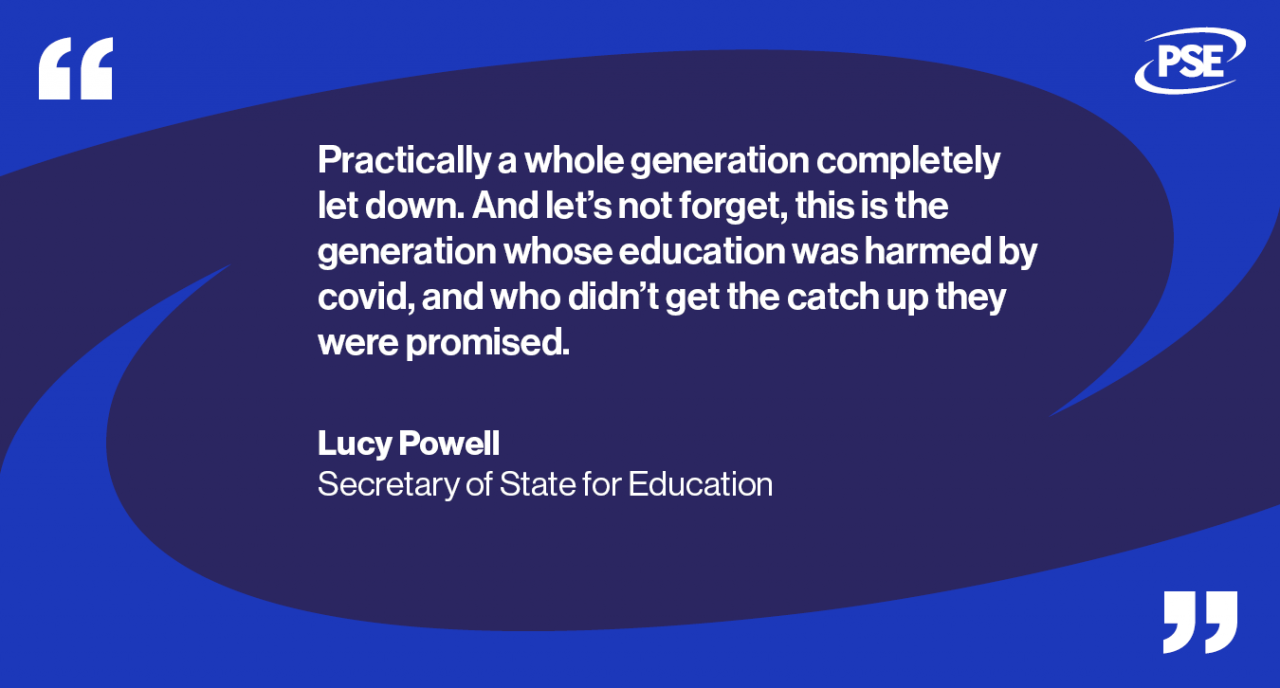
“Practically a whole generation completely let down. And let’s not forget, this is the generation whose education was harmed by covid, and who didn’t get the catch up they were promised.
“This is the generation whose Sure Start was cancelled…whose youth services were cut…whose futures were sold short.
And they were educated in a one-size-fits-all system. It’s worked for some, but it’s left far too many behind.”
Alongside the immediate push to reduce NEET numbers, the government says it is pursuing longer-term reforms aimed at addressing the root causes of disengagement.
These include plans to create a more engaging national curriculum, introduce new Level 1 qualifications to reduce repeated GCSE English and maths resits, reform the SEND system, expand vocational pathways through new V Levels and vocational GCSEs, and give local leaders a stronger role in shaping 16-to-19 education provision.
For public sector leaders, colleges, local authorities and skills providers, the initiative signals a significant shift towards localised intervention and stronger employer engagement as the government seeks to prevent a lost generation emerging from the post-pandemic education system.
Image credit: iStock