


The Government has launched a national consultation on children’s use of mobile phones and social media, setting out the next steps in its plan to improve children’s wellbeing online and support healthier digital habits.
The proposals aim to ensure children develop a balanced relationship with technology while building on wider reforms to give every child the best possible start in life, including a revised national curriculum and stronger skills training.
As part of immediate action, Ofsted will now check schools’ mobile phone policies during every inspection, with schools expected to be phone‑free by default. Updated guidance will make clear that pupils should not have access to personal mobile phones during lessons, breaks, lunch times or between classes. Ofsted will also assess how effectively policies are enforced when considering behaviour standards. Schools experiencing difficulties will receive targeted one‑to‑one support from Attendance and Behaviour Hub schools with proven approaches to phone bans.
The move comes amid growing concern that excessive screen time is affecting young people’s health, concentration and wellbeing. To better support families, the Government will publish evidence‑based screen time guidance for parents of children aged 5 to 16, alongside separate guidance for parents of under‑fives due in April.
While nearly all schools already have mobile phone policies – covering 99.9% of primary schools and 90% of secondary schools – usage remains widespread. National data shows that 58% of secondary pupils report phones being used without permission in lessons, rising to 65% among Key Stage 4 pupils. The strengthened guidance will also set expectations for teachers and staff, including that staff should avoid using personal phones in front of pupils, reinforcing positive behaviour standards.
The consultation will explore whether further action is needed, including examining global evidence on the effectiveness of potential social media age restrictions. Ministers will visit Australia to learn from its experience and consider how similar approaches might work in the UK. Other options under review include raising the digital age of consent, introducing phone curfews, and limiting addictive design features such as infinite scrolling and “streaks”.
Backed by a nationwide programme of engagement events with parents, young people and civil society, the consultation forms part of a wider national conversation on children’s digital lives. The Government has committed to publishing its response in the summer.
Liz Kendall, Secretary of State for Technology, said:
“Through the Online Safety Act, this government has already taken clear, concrete steps to deliver a safer online world for our children and young people.
“These laws were never meant to be the end point, and we know parents still have serious concerns. That is why I am prepared to take further action.
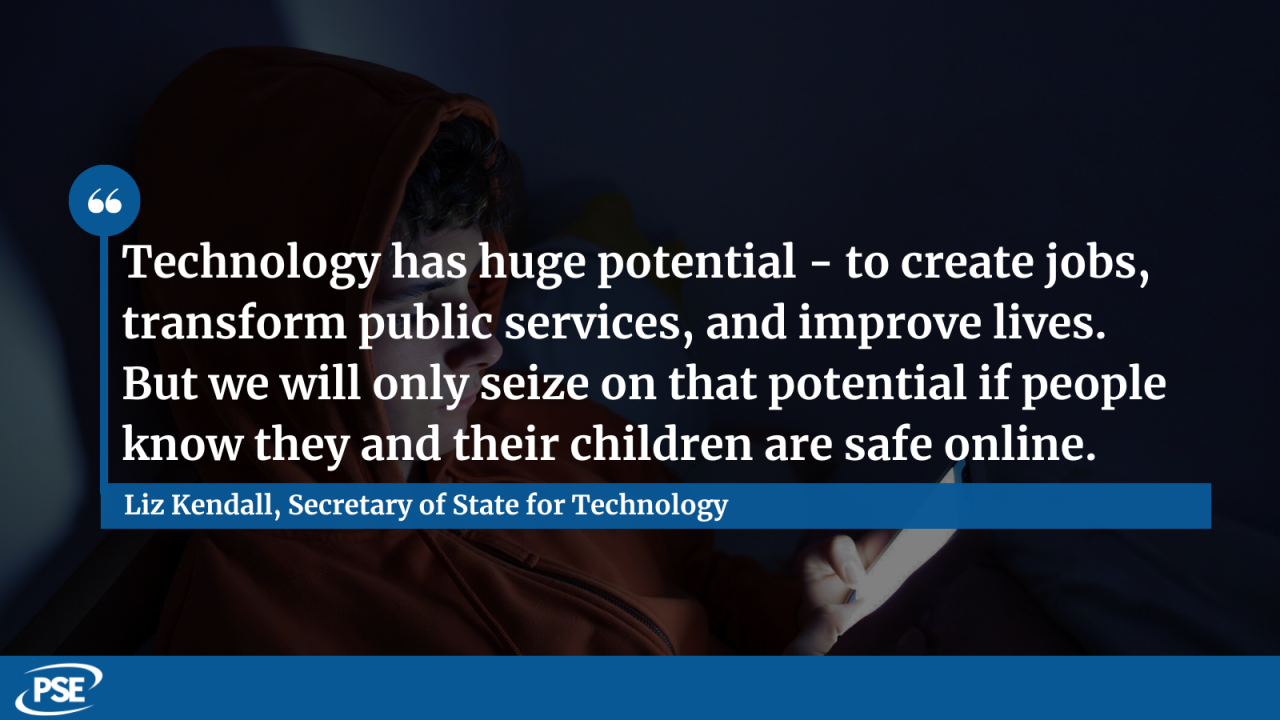
“Technology has huge potential - to create jobs, transform public services, and improve lives. But we will only seize on that potential if people know they and their children are safe online.
“We are determined to ensure technology enriches children’s lives, not harms them - and to give every child the childhood they deserve.”
The proposals build on the UK’s world‑leading Online Safety Act, which has already strengthened protections for children online. Since age‑verification rules came into force in July 2025, visits to pornography websites have fallen by around one third, and 8 million users now access adult sites daily with age checks in place. The proportion of people encountering age checks online has risen from 30% to 47%, while 58% of parents say the measures are making children safer.
The Government has also taken further action to protect children, including making cyberflashing a priority offence, requiring the removal of content encouraging serious self‑harm, announcing plans to ban AI “nudification” tools, and preventing the sharing or viewing of nude images by children on digital devices.
Alongside this, new global safety standards for AI in education were unveiled at the Government‑led Global AI in Education Summit this week. Shaped by feedback from thousands of pupils, the standards are designed to prevent the use of addictive or exploitative features in educational technology.
Ministers say the consultation marks another step in making inclusive, healthy digital behaviour the norm, both in schools and at home, while complementing wider initiatives such as the National Youth Strategy, which focuses on enriching children’s lives offline as well as online.
Image credit: iStock