


UK Research and Innovation has published its first‑ever plan to put artificial intelligence at the heart of national research and innovation. The strategy outlines how AI will be used to accelerate breakthroughs in science, create new public services, support industry growth and help deliver cutting‑edge products.
The announcement builds on the UK’s long‑established strengths in computing, mathematics and emerging agentic AI, and follows the government’s recent Spending Review which committed £1.6 billion of targeted AI funding through UKRI from 2026 to 2030 – the organisation’s largest single investment area.
UKRI‑funded AI research is already delivering real‑world impact, with examples including:
- The RADAR AI system detecting faults across the rail network in real time, helping prevent delays and service disruptions.
- The IXI Brain Atlas, now supporting more than 40 clinical trials into neurodegenerative conditions such as Alzheimer’s, by improving analysis of brain scans.
- AI tools helping detect online harms and support safety across digital platforms.
The new strategy aims to scale up and accelerate this impact across society, the economy and the public sector.
UKRI’s strategy commits to major new investment in the underlying disciplines that power AI, including mathematics, computer science, and engineering.
It also pledges to expand doctoral and fellowship programmes co‑designed with businesses, and to strengthen recognised career pathways for research software engineers, data scientists, and AI ethics specialists. The goal is to develop a strong, diverse talent pipeline and create high‑quality jobs across the UK’s growing AI sector.
The strategy aligns with wider themes of the India AI Impact Summit, which is currently highlighting international collaboration and AI‑enabled solutions.
Under the new plan, UKRI’s AI investment will focus on six priority areas:
- Advancing AI technology development
- Transforming research through AI tools and methods
- Developing AI skills and talent
- Accelerating innovation for economic and societal benefit
- Championing responsible and trustworthy AI
- Building world‑class AI data and computational infrastructure
This coordinated approach aims to position the UK as a global leader in safe, high‑impact AI.
Some of the headline commitments include up to £137 million (via DSIT’s AI for Science Strategy) to boost AI‑enabled scientific discovery, beginning with drug discovery and new treatments, and £36 million to upgrade the University of Cambridge’s DAWN supercomputer, enabling breakthroughs in fields such as healthcare diagnostics and environmental modelling.
These investments will help streamline the pathway from fundamental research to prototype development and commercial scale‑up.
Deputy Prime Minister David Lammy said:
“The UK is backing its pioneering AI leadership with more than £1.6 billion in investment to make sure the best of British expertise develops the next wave of AI innovations. Together we are turning potential into progress and that’s the ambition I am bringing to the AI Summit in India this week.
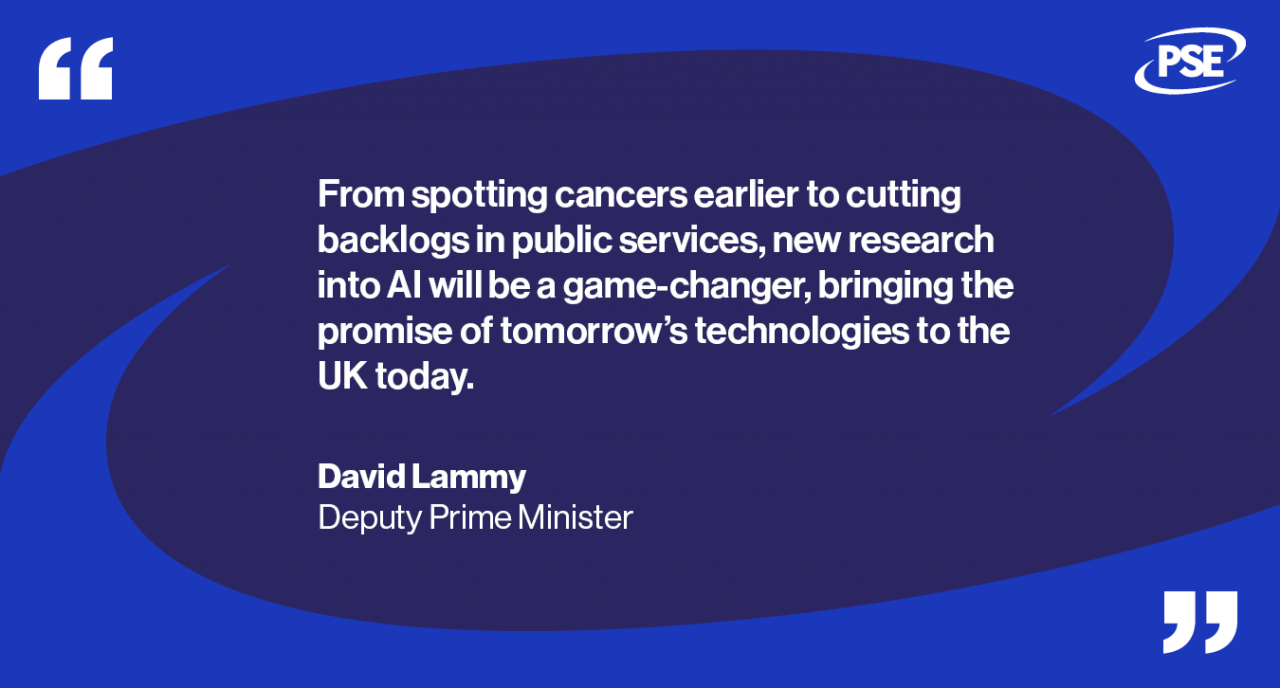
“From spotting cancers earlier to cutting backlogs in public services, new research into AI will be a game-changer, bringing the promise of tomorrow’s technologies to the UK today.”
AI is identified as one of the UK’s core growth sectors. The new strategy aims to strengthen regional innovation clusters, back AI‑enabled businesses, support technologies with high future economic value, and make research processes faster, more efficient and more collaborative.
Image credit: iStock