

A new report from IPPR North warns that the government’s plan to abolish district councils and replace them with large unitary authorities could move residents further away from decision‑making unless community empowerment is built into the process.
The think tank argues that local government reorganisation – a once‑in‑a‑generation change – offers a rare opportunity to modernise how local democracy works, but only if reforms shift power “downwards by default”.
According to the report, England already has some of the largest councils by population and fewer councillors per resident than many European countries. Under current proposals, population size per council is expected to rise from around 115,000 residents to as many as 500,000, significantly increasing the number of people each elected representative is responsible for.
Researchers warn that this could weaken accountability and distance residents from democratic decision-making unless deliberate steps are taken to strengthen local participation.
IPPR North’s research highlights examples of areas where community-led bodies have increased participation and improved outcomes. These examples included local ownership of social hubs, higher civic engagement and greater influence over neighbourhood priorities.
To support this model, the report recommends:
- Establishing community‑led neighbourhood boards with at least 50% local resident representation
- Allowing communities to request powers from unitary and strategic authorities
- Creating “democracy within walking distance” through participatory budgeting, neighbourhood decision‑making and other hyperlocal democratic tools
The report argued these measures would ensure reforms bring decision‑making closer to people rather than concentrating it further away.
The think tank noted that government investment in local communities, including through the Pride in Place agenda, presents an opportunity to couple physical regeneration with democratic renewal. It recommends ensuring community power‑sharing complements ongoing devolution efforts.
Researchers also cautioned that if devolution is to remain a flagship national policy, it must give residents meaningful influence over where they live, rather than simply changing governance structures at the top.
Research Fellow at IPPR North, Dr Ryan Swift, commented:
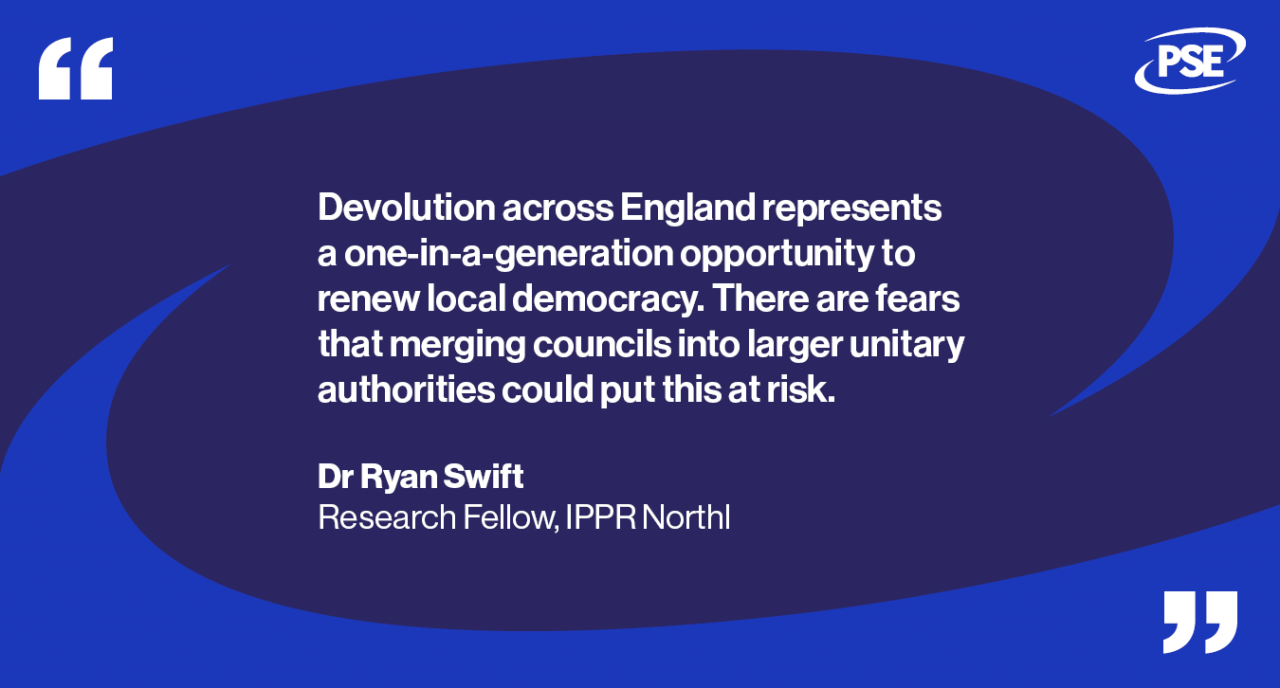
“Devolution across England represents a one-in-a-generation opportunity to renew local democracy. There are fears that merging councils into larger unitary authorities could put this at risk.
“But if devolution and local government reorganisation is accompanied by a deliberate commitment to community-led, participatory governance it can become a catalyst for genuine community empowerment and local democratic renewal.
“There is no choice but for devolution to work.”
IPPR North identifies three main areas for action:
- Double down on devolution and give community groups the right to request powers from new unitary authorities.
- Roll out community-led neighbourhood boards across restructured areas to give residents real influence over local priorities.
- Expand “democracy within walking distance” through hyperlocal participation tools, such as local budgets and neighbourhood decision-making forums.
The report concluded that reorganisation could revitalise local democracy — but only if reforms genuinely empower residents and ensure communities retain a strong voice within new, larger governance structures.
Image credit: iStock