

Thousands of vulnerable teenagers across England risk falling through the cracks due to incomplete local authority data on whether they are in education, employment or training (NEET), prompting urgent action from government.
New figures reveal that 32,100 so-called “Phantom NEETs” remain unaccounted for, creating a stark postcode lottery in how effectively councils can identify and support at-risk young people. In some areas, the scale of the challenge is significant: North Lincolnshire Council has reported missing data for almost half of its 16- and 17-year-olds, while four councils claim to know the status of every young person in that age group.
The issue sits alongside official statistics released in March, which estimate that around 57,000 16- and 17-year-olds are currently NEET. More broadly, over one million young people are not in education, employment or training across the UK.
Government steps up intervention
In response, the Education Secretary is writing to all local authorities outlining expectations for better tracking and earlier intervention. A separate letter will be issued to 26 councils facing the greatest challenges – those unable to account for 3% or more of their teenagers – with improvement plans to be agreed over the next six months.
Central to this push is the rollout of a new Risk of NEET Indicator (RONI) tool. This system brings together data points such as poor attendance, special educational needs, care experience and mental health factors, enabling councils to identify young people at risk earlier and target support more effectively.
At the same time, new guidance for schools and colleges aims to strengthen frontline identification of students most likely to disengage from education or training.
Widening regional disparities
The latest data underlines sharp regional disparities. Participation in education and apprenticeships currently ranges from 71.8% to 94.2% across different parts of the country, reinforcing concerns that opportunities for young people vary significantly depending on where they live.
Education Secretary Bridget Phillipson said:
“This is one of the defining challenges of this government. Fixing it is crucial to the prosperity of our country: we cannot afford to let a generation of young people drift away from opportunity and more fulfilled lives.
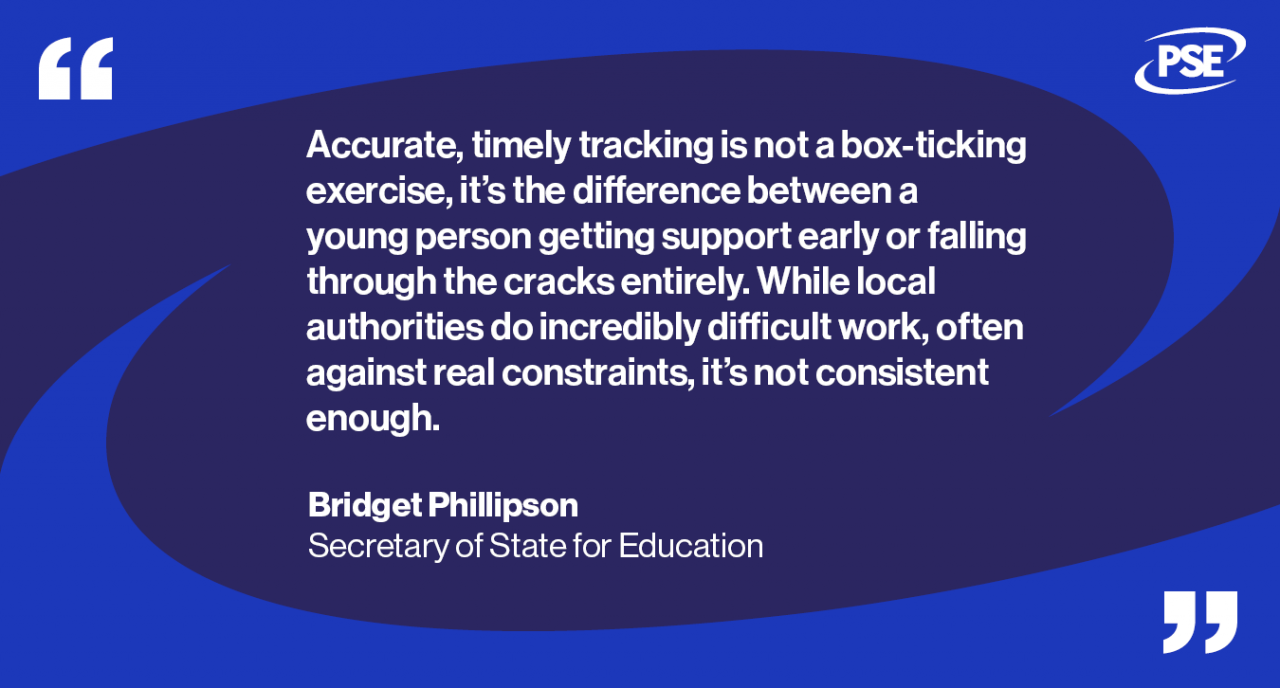
“Accurate, timely tracking is not a box-ticking exercise, it’s the difference between a young person getting support early or falling through the cracks entirely. While local authorities do incredibly difficult work, often against real constraints, it’s not consistent enough.
We’re supporting councils to intervene early to help, as part of our new deal for young people, to ensure they realise their potential through worthwhile training and stable careers.”
Major reforms and funding commitments
The measures sit within a broader package of youth employment reforms backed by £2.5 billion, designed to support nearly one million young people and create up to 500,000 “earn and learn” opportunities.
A major investigation commissioned by the Department for Work and Pensions and spearheaded by Alan Milburn is examining the systemic barriers preventing young people from accessing employment.
Key initiatives include:
- A £2,000 incentive for small businesses taking on apprentices aged 16–24
- Expansion of the Jobs Guarantee from autumn 2026, offering eligible young people on Universal Credit 25 hours per week of fully subsidised paid work for six months
- Automatic enrolment pilots into further education for those without confirmed places
- Continued rollout of technical pathways, including new V Levels and expanded T Levels
Participants in the Jobs Guarantee scheme will receive the relevant minimum wage along with wraparound support, providing a structured route back into employment or training.
A more targeted approach to prevention
RONI tools are expected to play a critical role in shifting the system towards prevention rather than reaction. By assigning risk scores to individual young people, councils can intervene earlier – whether by securing a college placement, arranging mental health support, or providing tailored engagement activities.
Additional investment of £3.5 billion is also being directed towards helping young people with health conditions enter the workforce by the end of the decade.
Closing the gap
The government’s wider ambition is to ensure no young person is left behind due to gaps in data or inconsistent local practice. However, with such wide variation in current performance, delivering consistent, high-quality support across all regions remains a significant operational challenge for councils.
For local government leaders and public sector professionals, the message is clear: better data, earlier intervention and stronger collaboration between education, employment and health services will be essential to preventing vulnerable young people from becoming disengaged.
Image credit: iStock