

Twelve coastal authorities across England are set to share more than £11.2m in government funding to help communities adapt to the growing threat of coastal erosion and climate change.
The investment, announced through the government's Coastal Adaptation Pilots programme, will support local authorities in developing new approaches to managing shoreline change, strengthening resilience and helping residents prepare for future risks.
The funding comes as the Environment Agency warns that around 20,000 homes and businesses in England could be at risk from coastal change by 2105. Ministers say the programme will help councils move beyond reactive responses and plan for long-term impacts on communities, infrastructure and local economies.
Projects receiving support include the use of advanced drone technology in North Yorkshire, community-led adaptation planning in Cornwall, and three-dimensional cliff modelling in Somerset.
Floods Minister Emma Hardy said:
“Rising sea levels and more frequent storms are wearing away our coastline, and we are investing millions to protect the homes and businesses it affects.
“Through our pilots, we are arming communities with new and innovative solutions, like high-tech drones and cliff monitoring, to ensure they adapt swiftly.
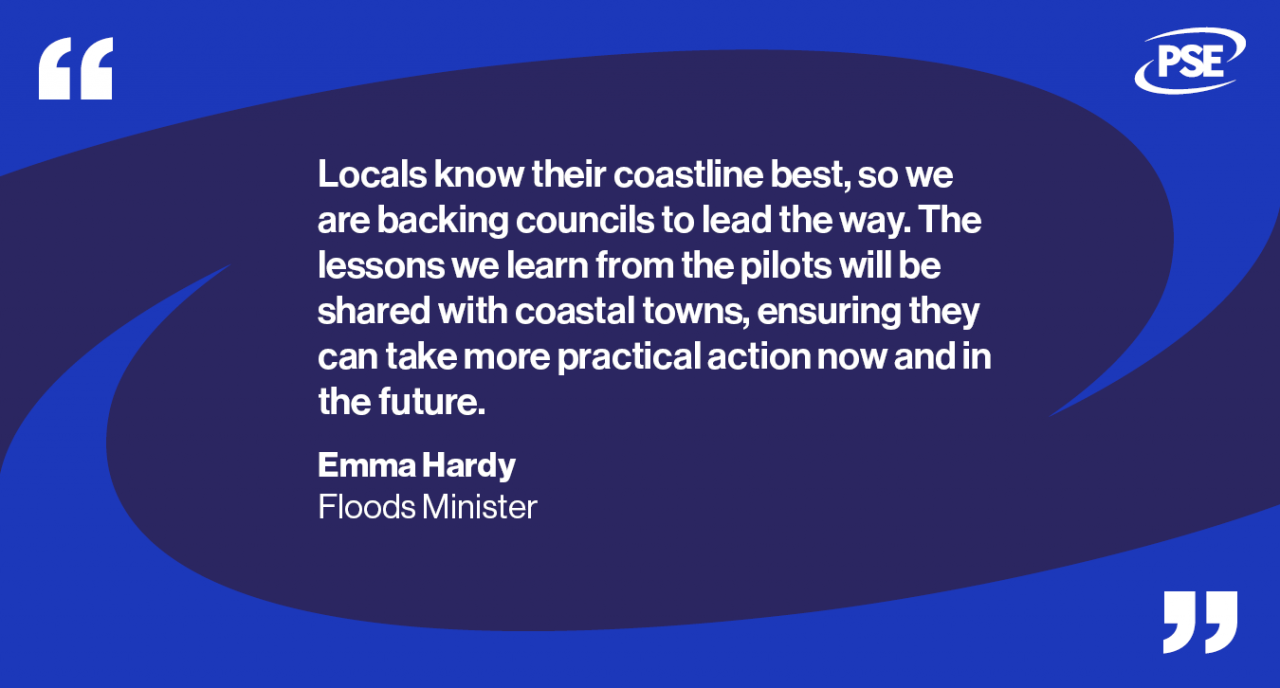
“Locals know their coastline best, so we are backing councils to lead the way. The lessons we learn from the pilots will be shared with coastal towns, ensuring they can take more practical action now and in the future.”
While traditional flood and coastal defences will remain a key part of protection strategies, government officials acknowledge that maintaining existing coastlines indefinitely may not always be viable. The pilot schemes are intended to work alongside existing defences, helping communities understand and prepare for inevitable changes.
The programme aims to enable councils to act before erosion becomes a crisis, reducing the risk of sudden disruption to homes, businesses, local services and tourism economies.
The latest funding builds on an earlier £18m investment awarded this year to advanced coastal adaptation projects in East Riding of Yorkshire, East Suffolk, Great Yarmouth and North Norfolk. Those schemes are exploring long-term solutions for households facing erosion, including proposals that could provide financial support for residents to relocate before properties become unsafe and are demolished.
All 12 pilot authorities will now work with local communities and delivery partners, supported by the Environment Agency, to refine and implement their projects through to March 2029.
North Yorkshire: using drones to improve cliff monitoring
North Yorkshire Council has secured £970,000 to deliver a package of projects focused on cliff monitoring, adaptation planning and maintaining coastal access.
The council will deploy LiDAR-enabled drones to identify cliff movement at an earlier stage, improving both emergency response and long-term planning. Adaptation work will focus on Filey Flat Cliffs, where erosion could threaten roads and utility infrastructure.
At Cayton, the authority will test a modular coastal access route designed to respond to the potential loss of existing pathways, creating a model that could be replicated elsewhere.
Somerset: helping Watchet prepare for future change
Somerset Council has been awarded £290,000 to work with residents and businesses in West Watchet, where cliff movement continues to threaten homes and infrastructure.
The project follows the closure of the B3191 due to erosion, while around 20 properties face direct or future risk from cliff instability.
Using advanced three-dimensional modelling alongside extensive public engagement, Somerset will create a publicly accessible Storymap to help residents understand local risks and support informed decision-making about the area's long-term future.
Cornwall: community-led resilience and natural coastal protection
Cornwall Council has received the largest allocation, with £2.6m to support a wide-ranging programme covering community adaptation planning, infrastructure resilience and nature-based solutions.
The authority will work with coastal communities to develop locally owned adaptation plans, building on lessons from the Future Coast Bude initiative. Further engagement is planned with communities including Newquay.
Additional projects will focus on dune monitoring and management across Cornwall, Devon and the Isles of Scilly, alongside community science initiatives, sediment management, highway adaptation measures and practical storm-response tools.
The pilots are expected to provide valuable evidence for other coastal communities facing similar challenges, helping shape future approaches to coastal adaptation across England.
Image credit: iStock