
England’s councils will have access to almost £78 billion for essential services next year, as the government announces a radical overhaul of local government funding. The new system will direct more money to areas with the greatest need, helping restore community pride and strengthen local services.
The funding forms the first multi‑year Local Government Settlement in more than ten years, giving councils three years of financial certainty to plan staffing, local investment, and service improvements – instead of firefighting year by year.
By the end of the Settlement period, councils will receive an over 23% increase in core spending power compared with 2024–25, supporting services such as bin collections, housing, children’s services, libraries, youth services, and community hubs.
The government is replacing the outdated system that allowed some councils to accumulate cash reserves while others faced the risk of financial crisis. In its place is an evidence‑based model that better reflects local needs, deprivation levels, and the true cost of providing services.
As a result, the most deprived 10% of councils will see a 24% per‑person boost in available funding.
To ensure stability, all councils will be financially protected during the transition. Funding changes will be phased in gradually, ensuring a smooth shift to the new formula without disruption to frontline services.
The £600 million Recovery Grant, introduced last year, will continue throughout the new multi‑year settlement, and will remain targeted at councils hit hardest by prolonged underfunding. A new Recovery Grant Guarantee will give upper‑tier councils above‑inflation increases as they move onto the new system.
While councils must continue managing budgets responsibly, council tax rises will be capped at 3% per year, with an additional 2% flexibility for adult social care. Local leaders will decide whether to use this flexibility.
In exceptional cases, councils may apply to exceed the cap – but only if their residents do not already pay above‑average bills.
Six councils with historically low council tax (Wandsworth, Westminster, Hammersmith and Fulham, City of London, Kensington and Chelsea, and Windsor and Maidenhead) will have two‑year flexibility to raise bills. Around 500,000 households in these areas currently pay £450 to £1,280 less than the national average for a Band D property.
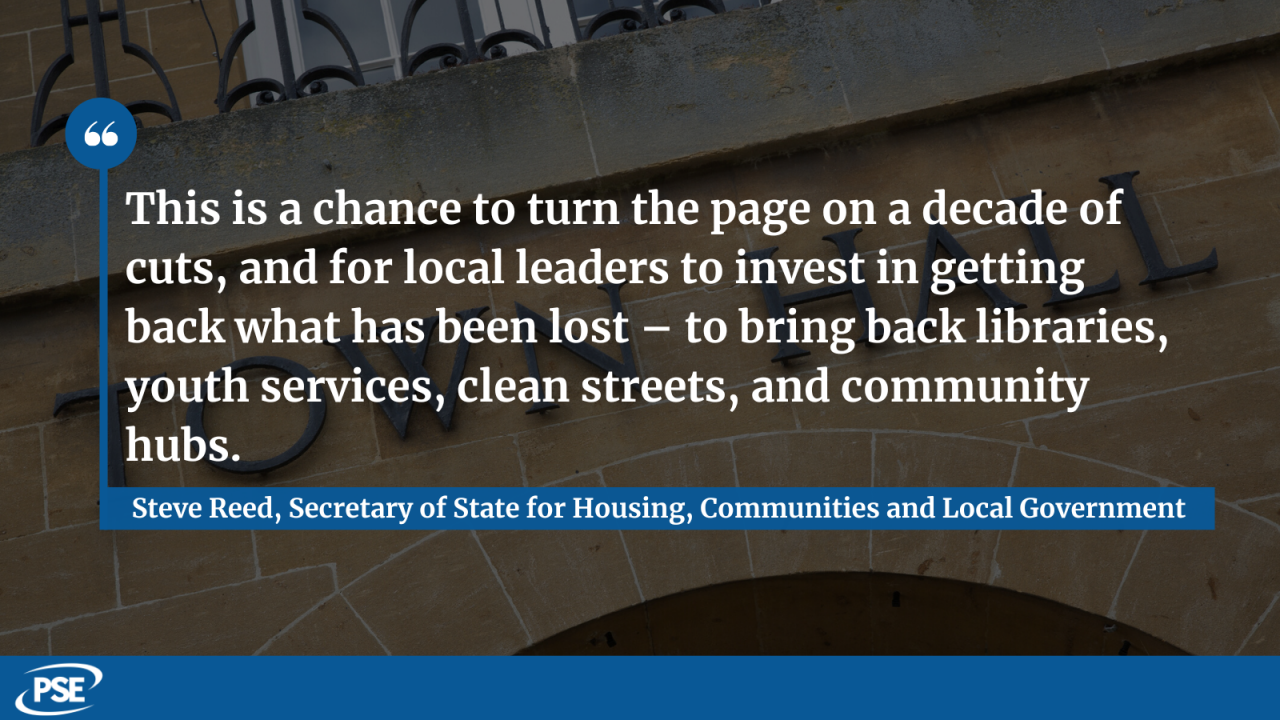
Secretary of State Steve Reed commented:
“This is a chance to turn the page on a decade of cuts, and for local leaders to invest in getting back what has been lost – to bring back libraries, youth services, clean streets, and community hubs.
“Today we’re making sure every community has the funding they need to succeed.”
The government reaffirmed its commitment to building a National Care Service, with £4.6 billion additional funding for adult social care by 2028–29, including £500 million to improve pay for care workers.
Children’s social care will undergo the biggest transformation in a generation, backed by £2.4 billion over the Settlement period.
The Settlement includes several other major changes:
- Fairer housing incentives: Councils keep all additional council tax from new homes, encouraging local growth and homeownership.
- Reduced bureaucracy: Streamlining 36 funding streams worth more than £56 billion over three years.
- More planning capacity: Investment to ensure councils can focus on residents’ priorities and unlock development at pace.
Alison McGovern, Minster of State for Local Government and Homelessness, added:
“Deprivation doesn’t happen by accident – it’s the result of years of broken systems and wrong priorities. This settlement tackles that head-on by directing funding where it’s needed most.
“By fixing the link between funding and deprivation, we’re giving local areas the tools to create opportunities, support families, and rebuild the services that hold communities together. This is how we deliver a fairer Britain where everyone has the chance to succeed.”
Combined, these measures aim to rebalance inequalities, restore local services and rebuild public trust – supporting the government’s mission to rejuvenate communities across England.
Image credit: iStock